


Description
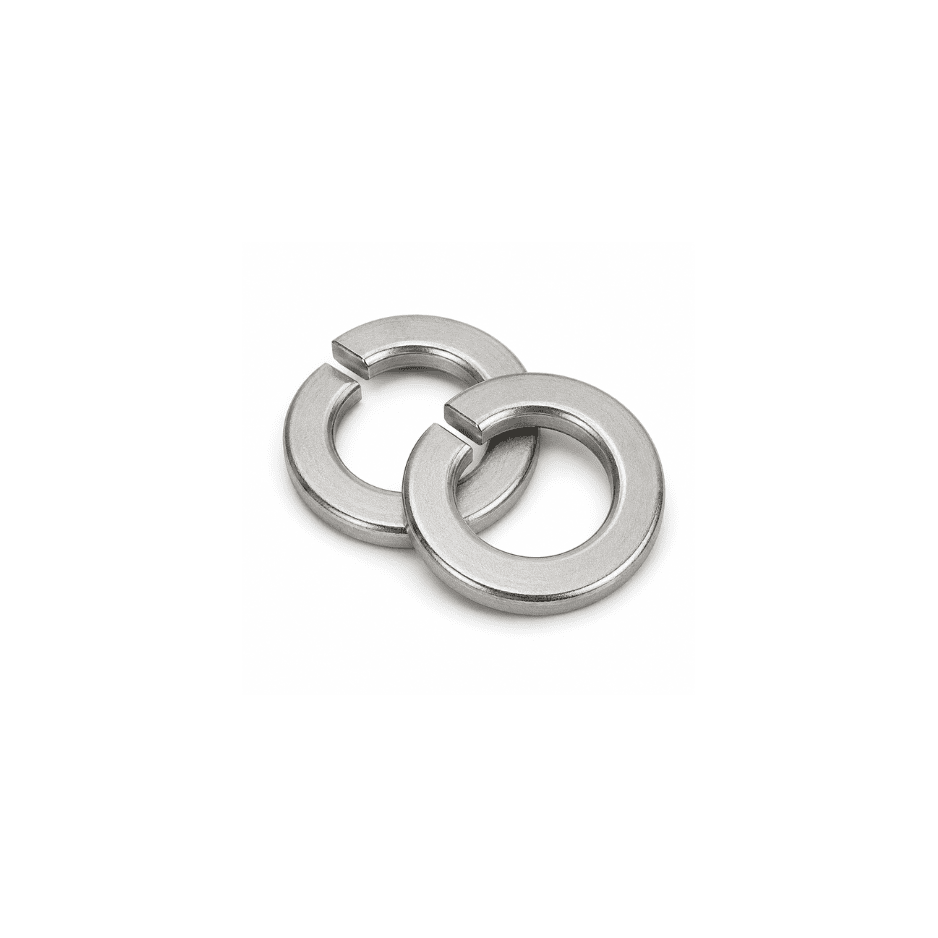
AM Steel Spring Washers are split metal rings bent into a single-coil helical shape, designed to sit between a bolt head or nut and the mating surface. As the nut is tightened, the washer compresses and flattens, storing elastic (spring) energy that continuously pushes back against the joint – creating frictional resistance that helps counteract the loosening effect of vibration and thermal cycling. Manufactured under the AM Steel brand, these split spring washers are available in two cross-section profiles: flat (rectangular) section, made to DIN 127 (with IS 3063 and BS 1802 as equivalent standards), and square section, made to DIN 7980 (with IS 6735 and BS 1802 as equivalent standards).
The choice between flat and square section comes down to the spring force required for the application: a square-section spring washer of the same nominal size generally provides greater stiffness and spring force than a flat-section washer, making it a common choice for heavier machinery and higher-vibration environments, while flat-section washers are the more widely available, general-purpose option. Within the flat-section range, AM Steel also offers DIN 127 Type A (with a bent-up tang at both ends) and Type B (with plain, square-cut ends) – both function identically, with the difference being largely a manufacturing and preference detail rather than a performance one.
AM Steel spring washers are manufactured from high-carbon spring steel (such as 65Mn or 60Si2Mn) for general industrial use, and stainless steel (A2/304 and A4/316) for corrosion-resistant applications. It’s worth noting that a spring washer’s ability to resist loosening comes primarily from the friction and preload it maintains, rather than true mechanical locking – for genuinely safety-critical or high-vibration joints, many engineers now specify alternative methods (such as correctly torqued bolts with thread-locking compound, or prevailing-torque lock nuts) alongside or instead of spring washers, so always confirm what your application’s engineering specification calls for. Whether you’re assembling general machinery, automotive components, or structural connections, AM Steel spring washers provide a widely trusted, cost-effective option for basic vibration resistance. As with all AM Steel products, this spring washer is available in metric sizing (M2 to M76, per DIN 127/7980), in multiple grades, materials, and finishes to suit both industrial-grade and everyday fastening needs.
Key features:
- Split, single-coil helical design creates spring force to resist loosening
- Available in flat (rectangular) section (DIN 127) and square section (DIN 7980)
- Square section offers greater spring force per size than flat section
- DIN 127 available in Type A (tang ends) and Type B (square ends)
- Available in high-carbon spring steel and stainless steel (A2/304, A4/316)
- Backed by the quality assurance of AM Steel
Ideal For
AM Steel Spring Washers (Flat/Square Section) are ideal for:
- General machinery and equipment assemblers needing basic vibration resistance on bolted joints
- Automotive technicians securing components subject to engine or road vibration
- Construction and structural contractors using spring washers as a supplementary anti-loosening measure
- Electrical and panel installers securing terminal and mounting hardware
- General maintenance and repair work wherever a simple, widely available lock washer is needed
Choosing the Right Spring Washer
Selecting the correct spring washer from the AM Steel range depends on several factors:
- Cross-Section – Flat (rectangular) section for general-purpose use; square section where greater spring force and stiffness are needed for heavier machinery or higher-vibration environments.
- Type (Flat Section Only) – DIN 127 Type A (tang ends) or Type B (square ends) – functionally equivalent, choice often based on availability or preference.
- Material – Stainless steel (A2/304 or A4/316) for corrosive or outdoor environments; high-carbon spring steel for general industrial use where maximum spring force is prioritized.
- Size – Match the washer’s inner diameter to the bolt or screw diameter, per DIN 127/7980 sizing.
- Bolt Property Class – Historically, DIN 127 spring washers were intended for use with property class 8.8 bolts or lower; consult current application standards for higher-grade bolts.
- Application Criticality – For safety-critical or high-vibration joints, evaluate whether a spring washer alone is sufficient or whether additional locking methods (thread-locking compound, prevailing-torque nuts) are also warranted.
Strategies to Choose the Right Product
- Choose square section for higher vibration or load demands – Use square-section spring washers where greater stiffness and spring force are needed compared to a flat-section washer of the same size.
- Match material to environment – Choose stainless steel (A2/304 or A4/316) for corrosive, outdoor, or washdown environments; spring steel for general indoor industrial use.
- Don’t rely on spring washers alone for safety-critical joints – Consider supplementary locking methods (thread-locking compound, prevailing-torque lock nuts) for high-vibration or safety-critical applications, per current engineering best practice.
- Buy in matched sets – Purchase spring washers alongside compatible bolts and nuts sized to the correct diameter.
- Prioritize certified standards – Look for DIN 127/DIN 7980 (or equivalent IS/BS) compliance for guaranteed dimensional and spring-force consistency.
- Consider bulk vs. individual packs – Bulk packs suit production assembly or large construction projects; smaller packs suit repairs or small builds.
Mechanical Properties
AM Steel Spring Washers (Flat/Square Section) are manufactured to meet recognized mechanical and dimensional standards, ensuring reliability across general assembly, automotive, and construction applications:
| Property | Specification |
|---|---|
| Material Grades | High-Carbon Spring Steel (e.g., 65Mn, 60Si2Mn), Stainless Steel (A2/304, A4/316) |
| Governing Standards | DIN 127 (flat/rectangular section), DIN 7980 (square section); equivalent IS 3063/IS 6735 and BS 1802 |
| Cross-Section Types | Flat (rectangular) section; Square section |
| DIN 127 Sub-Types | Type A (bent tang ends), Type B (plain square ends) |
| Design Function | Split, single-coil helical spring providing preload-maintaining spring force |
| Size Range | M2 to M76 (metric), per DIN 127/7980 |
| Directionality | Left-hand helix; permits tightening in right-hand direction |
| Hardness Testing | Rockwell hardness (HRC scale) per manufacturer quality control |
| Corrosion Resistance | Moderate (plain/plated spring steel) to high (A2/A4 stainless steel) |
| Surface Finish | Plain, zinc-plated, black oxide, passivated stainless steel |
These mechanical ratings confirm that AM Steel spring washers provide reliable spring-force resistance to loosening – always verify against current application standards whether a spring washer alone is sufficient for higher-grade bolts or safety-critical joints.
Frequently Asked Questions (FAQs)
1. What is a spring washer used for? A spring washer is used beneath a bolt head or nut to create a spring force that helps resist loosening caused by vibration or thermal cycling in a bolted joint.
2. What’s the difference between a flat section and square section spring washer? A flat (rectangular) section spring washer has a wider, thinner cross-section, while a square section spring washer has an equal-sided cross-section that generally provides greater stiffness and spring force for the same nominal size.
3. Are AM Steel spring washers different from generic spring washers? AM Steel spring washers are manufactured and quality-tested under the AM Steel brand, ensuring consistent dimensions, spring force, and finish across every batch, per DIN 127/DIN 7980.
4. What’s the difference between DIN 127 Type A and Type B? Type A has a bent-up tang at both ends of the washer, while Type B has plain, square-cut ends; both function identically as split spring lock washers, with the difference being largely a manufacturing or preference detail.
5. How does a spring washer actually prevent loosening? When compressed during tightening, the washer stores elastic (spring) energy and pushes back against the joint, maintaining frictional resistance between the bolt, washer, and substrate — this is a friction-based effect rather than a true mechanical lock.
6. Are spring washers corrosion-resistant? Yes, especially AM Steel stainless steel spring washers (A2/304 or A4/316), which resist rust in outdoor, marine, or corrosive environments; spring steel offers less protection unless plated or coated.
7. What sizes do spring washers come in? AM Steel spring washers are available in a range of sizes, typically M2 to M76 in metric, across both flat and square section profiles, per DIN 127/DIN 7980.
8. Are spring washers suitable for high-grade or high-vibration bolted joints? Spring washers were historically specified for use with bolts up to property class 8.8; for higher-grade bolts or particularly high-vibration or safety-critical joints, many current engineering practices favor supplementary methods such as thread-locking compound or prevailing-torque lock nuts, so it’s worth checking your application’s specific standard.
9. Can spring washers be reused? Not reliably – while a spring washer may appear intact after removal, its spring properties can be significantly compromised once flattened and loaded, so replacement is generally recommended for critical applications.
10. What’s the difference between a split spring washer (DIN 127) and a curved/wave spring washer (DIN 128)? A split spring washer (DIN 127) is directional – its left-hand helix only permits tightening in one rotational direction — while a curved or wave spring washer (DIN 128) is non-directional and can be tightened clockwise or counter-clockwise.
11. What materials are spring washers typically made from? Most commonly, high-carbon spring steel (such as 65Mn or 60Si2Mn) for general industrial use, with stainless steel A2 (304) and A4 (316) available for corrosive or outdoor environments.
12. What’s the difference between A2 and A4 stainless steel spring washers? A2 (304) stainless offers good general corrosion resistance for most indoor and outdoor use, while A4 (316) stainless provides superior resistance to chlorides and marine environments.
13. Why would I choose a square section spring washer over a flat section one? A square section spring washer provides greater stiffness and spring force for the same nominal size, making it a common choice for heavier machinery or applications with more demanding vibration resistance requirements.
Reviews
There are no reviews yet.