


Description
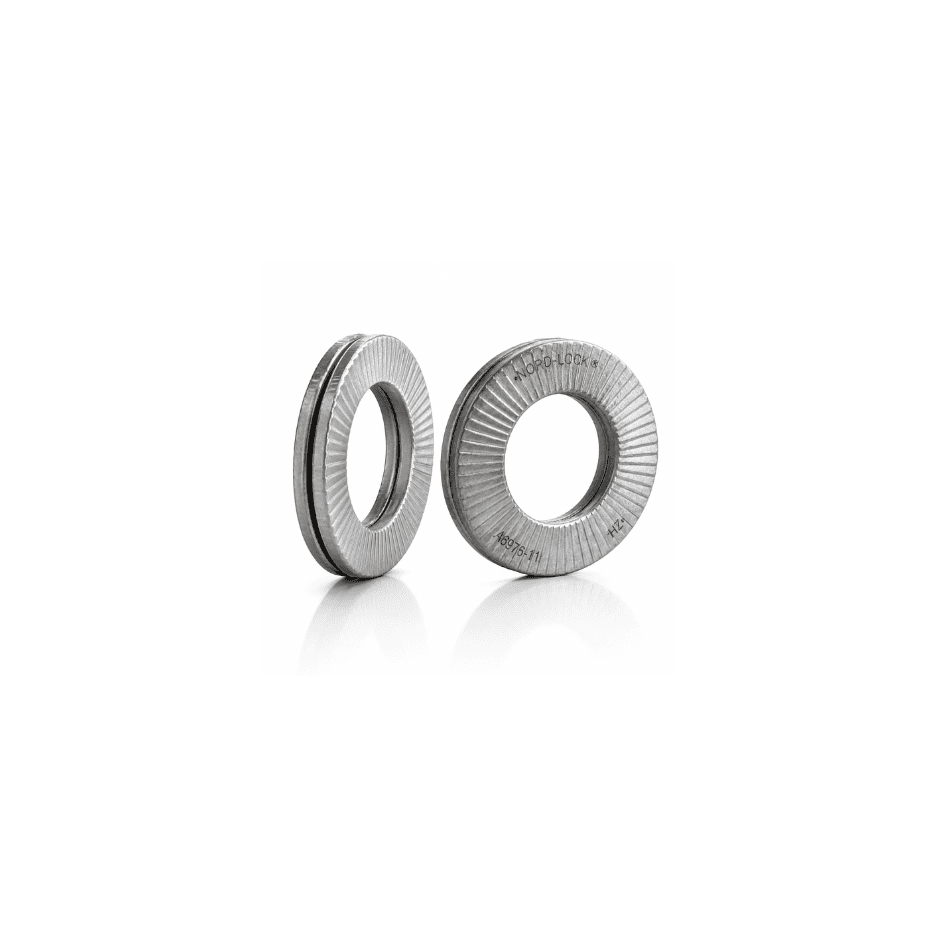
AM Steel Wedge Lock Washers work in matched pairs, each washer featuring radial teeth on its outer face (which grip the bolt head, nut, or mating surface) and cam-shaped ridges on its inner face (where the two washers interlock with each other). Manufactured under the AM Steel brand, this design – widely recognized across the industry by the generic term “wedge-locking washer” (a mechanism popularized under the trademarked name Nord-Lock, held by the Nord-Lock Group) – secures a bolted joint through tension rather than through the friction that conventional flat or spring washers rely on.
The locking action works because the cam angle on the interlocking faces is engineered to be steeper than the thread pitch of the bolt or screw being used. When the bolt attempts to rotate loose under vibration or dynamic load, the washer pair would have to expand – physically increase in height – to allow that rotation, and the cams’ geometry actively resists this expansion, locking the joint in place. This is a fundamentally different mechanism from a spring washer, which relies on stored spring force and surface friction and can lose effectiveness once flattened or if lubricant reduces friction at the joint.
AM Steel wedge lock washer pairs are manufactured in hardened carbon steel and stainless steel (A2/304, A4/316), with the washer hardness always specified higher than the mating bolt/nut surface to preserve the mechanical locking action. They are widely used in heavy machinery, structural steel connections, wind turbines, off-road and heavy vehicles, and any high-vibration or dynamic-load application where a conventional lock washer isn’t sufficient. As with all AM Steel products, this wedge lock washer is available in metric and imperial sizing, in multiple grades and finishes to suit both industrial-grade and precision fastening needs.
Key features:
- Paired-washer design locks joints via tension and mechanical wedging, not friction
- Cam angle engineered steeper than thread pitch to physically block loosening rotation
- Effective under both dry and lubricated conditions, unlike friction-dependent washers
- Available in hardened carbon steel and stainless steel (A2/304, A4/316)
- Washers can typically be reused if inspected and undamaged
- Backed by the quality assurance of AM Steel
Ideal For
AM Steel Wedge Lock Washers are ideal for:
- Heavy machinery and industrial equipment manufacturers securing bolted joints against continuous vibration
- Structural steel and wind turbine assembly requiring long-term, maintenance-free bolt security
- Off-road, heavy vehicle, and rail equipment builders facing extreme dynamic loads and vibration
- Oil, gas, and process industry maintenance teams needing joints that resist both dry and lubricated loosening conditions
- Critical safety applications where retightening or bolt failure from loosening is not an acceptable risk
Choosing the Right Wedge Lock Washer
Selecting the correct wedge lock washer from the AM Steel range depends on several factors:
- Material – Stainless steel (A2/304 or A4/316) for corrosive, outdoor, or marine environments; hardened carbon steel for general industrial use where maximum hardness is prioritized.
- Hardness Relative to Mating Surface – Confirm the washer’s hardness exceeds that of the bolt head, nut, and clamped surface, since the locking mechanism depends on this relationship.
- Size – Match the washer’s inner diameter to the bolt or screw diameter and confirm outer diameter clearance in the assembly.
- Standard/Configuration – Select the correct washer pair configuration for your bolt type (standard bolt/nut, stud, or steel construction HV/HR bolt sets) if the application follows a specific structural steel standard.
- Environmental Conditions – Confirm suitability for dry versus lubricated joints, and for the expected operating temperature range.
- Reuse Requirements – Since wedge lock washers are typically designed to be reusable, confirm inspection criteria if the joint will be disassembled and reassembled repeatedly.
Strategies to Choose the Right Product
- Match washer hardness to the joint’s mating surfaces – Always confirm the wedge lock washer is harder than the bolt head, nut, and clamped material, since this relationship is essential to the mechanical locking action.
- Choose wedge locking for genuinely high-vibration or safety-critical joints – Reserve this washer type for applications where a standard flat or spring washer has proven insufficient, since it is a higher-cost, higher-performance solution.
- Match material to environment – Choose stainless steel (A2/304 or A4/316) for corrosive or marine environments; hardened carbon steel for general industrial use.
- Install washer pairs correctly, cam face to cam face – Ensure the two washers in a pair are assembled with their cam surfaces facing each other for the locking mechanism to function as designed.
- Inspect before reuse – Check washer pairs for wear, deformation, or surface damage before reinstalling in a disassembled joint.
- Buy in matched sets – Purchase wedge lock washer pairs together (they are sold and function as matched sets, not individually) alongside compatible bolts and nuts.
Mechanical Properties
AM Steel Wedge Lock Washers are manufactured to meet recognized mechanical and functional performance standards, ensuring reliability across heavy machinery, structural, and high-vibration applications:
| Property | Specification |
|---|---|
| Material Grades | Hardened Carbon Steel, Stainless Steel (A2/304, A4/316) |
| Design Principle | Paired washers with radial teeth (outer face) and cam ridges (inner, interlocking face) |
| Locking Mechanism | Mechanical wedging via tension; cam angle steeper than bolt thread pitch |
| Hardness Requirement | Washer hardness must exceed hardness of mating bolt/nut/clamped surface |
| Locking Performance | Effective under both dry and lubricated conditions; independent of friction coefficient |
| Reusability | Designed to be reusable; inspect for wear/damage before reinstallation |
| Corrosion Resistance | Moderate to high depending on plating (carbon steel); high (A2/A4 stainless steel) |
| Operating Temperature Range | Varies by material; consult manufacturer data for extreme temperature applications |
| Surface Finish | Plain hardened steel, zinc/geomet coatings, passivated stainless steel |
These mechanical ratings confirm that AM Steel wedge lock washers provide tension-based, friction-independent joint security – always verify hardness compatibility with the mating bolt and nut before specifying for a critical application.
Frequently Asked Questions (FAQs)
1. What is a wedge lock washer used for? A wedge lock washer is used to secure bolted joints against loosening from vibration or dynamic loads, commonly in heavy machinery, structural steel, wind turbines, and off-road or heavy vehicle applications.
2. How is a wedge lock washer different from a spring washer? A wedge lock washer secures the joint through mechanical wedging and tension, working effectively even under lubricated conditions, while a spring washer relies on stored spring force and surface friction, which can be reduced by lubrication or lost once the washer flattens.
3. Are AM Steel wedge lock washers different from generic wedge-locking washers? AM Steel wedge lock washers are manufactured and quality-tested under the AM Steel brand, ensuring consistent cam geometry, hardness, and dimensional accuracy across every batch.
4. Is “Nord-Lock” the correct name for this type of washer? Nord-Lock is a registered trademark of the Nord-Lock Group for their specific branded wedge-locking washer products; “wedge lock washer” or “wedge-locking washer” is the correct generic term used across the industry for this washer mechanism in general.
5. How does a wedge lock washer prevent bolt rotation? The cam angle on the interlocking faces of the washer pair is engineered steeper than the bolt’s thread pitch, so any attempt by the bolt to rotate loose would require the washer pair to expand in height – a physical action the cam geometry actively resists.
6. Are wedge lock washers corrosion-resistant? Yes, especially AM Steel stainless steel wedge lock washers (A2/304 or A4/316), which resist rust in outdoor, marine, or corrosive environments; hardened carbon steel versions offer moderate protection depending on plating.
7. Do wedge lock washers work in both dry and lubricated joints? Yes, since the locking mechanism relies on mechanical wedging rather than friction, wedge lock washers remain effective in both dry and lubricated (oiled or greased) bolted joints.
8. Can wedge lock washers be reused? Yes, wedge lock washers are generally designed to be reusable, though they should be inspected for wear, deformation, or surface damage before being reinstalled, and reassembled correctly cam face to cam face.
9. Why does the washer hardness matter for wedge lock washers? The washer’s hardness must exceed the hardness of the bolt head, nut, and clamped surface for the mechanical locking action to function correctly – using washers softer than the mating surfaces can compromise the locking performance.
10. Are wedge lock washers sold individually or in pairs? Wedge lock washers are sold and function as matched pairs, since the locking mechanism depends on the two washers’ cam faces interlocking with each other.
11. What industries commonly use wedge lock washers? Common applications include heavy machinery, structural steel and wind turbine assembly, off-road and heavy vehicles, rail equipment, and oil, gas, and process industries facing continuous vibration or dynamic loads.
12. What’s the difference between A2 and A4 stainless steel wedge lock washers? A2 (304) stainless offers good general corrosion resistance for most indoor and outdoor use, while A4 (316) stainless provides superior resistance to chlorides and marine or offshore environments.
13. Are wedge lock washers more expensive than standard lock washers? Generally yes – the more complex paired-washer design and hardened material typically cost more than a standard spring or toothed lock washer, but this is often justified in applications where standard washers have proven insufficient against loosening.
Reviews
There are no reviews yet.