


Description
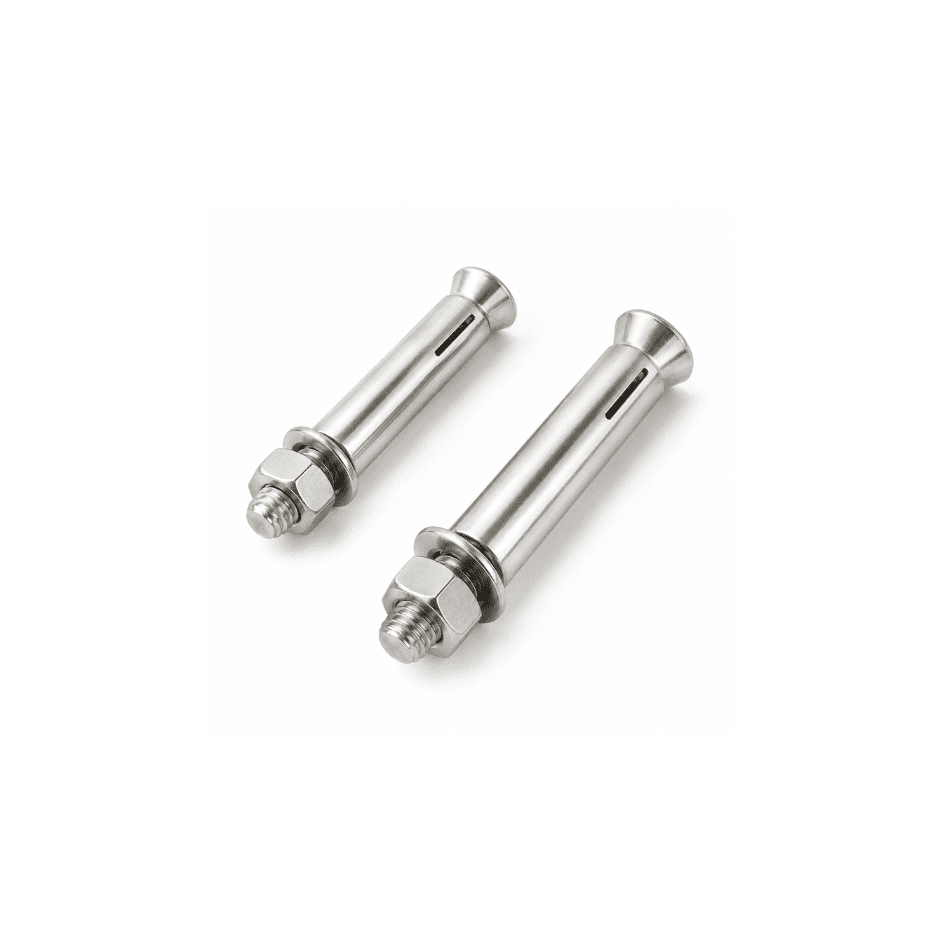
AM Steel Sleeve Anchor Fasteners are pre-assembled, four-part masonry anchors consisting of a threaded stud, an expansion sleeve, a washer, and a nut, ready to install as a complete unit. Manufactured under the AM Steel brand, as the nut is tightened, the stud is drawn upward, causing the expansion sleeve to compress and expand outward against the sides of the predrilled hole – because this expansion force is distributed along the sleeve’s full body length rather than concentrated in a single zone, sleeve anchors work reliably not just in solid concrete, but also in brick and both hollow and solid concrete block, where a wedge anchor’s more concentrated expansion clip would risk breaking through a thin block wall instead of developing holding force.
This versatility comes with a genuine trade-off: in solid concrete at the same diameter, a wedge anchor typically carries roughly 40 to 60 percent higher tension and shear capacity than a sleeve anchor, since the wedge anchor’s more concentrated expansion generates greater local friction. It’s also worth understanding that a sleeve anchor’s designated size refers to its outside diameter, while the internal stud is smaller – for example, a 3/8-inch sleeve anchor typically has a 5/16-inch stud, meaning its shear strength corresponds to the smaller stud diameter rather than the full nominal size. For this reason, most sleeve anchor product lines do not carry current ICC-ES code listings for structural applications, making sleeve anchors a strong choice for non-structural, non-code-required installations, but not a direct substitute for a code-listed wedge anchor on structural or seismic work.
AM Steel sleeve anchors are manufactured in carbon steel (zinc-plated) and 304 stainless steel, and are available in acorn head (a finished, open acorn nut appearance), hex head (standard hex nut, turned to expand the anchor), flat head (countersunk, sitting flush with the surface), and round head (slotted, for use with a straight screwdriver) configurations. Common applications include securing metal door frames, electrical boxes, light fixtures, conduit straps, cable trays, shelving brackets, and general medium-duty attachments to brick, block, or concrete. As with all AM Steel products, this sleeve anchor is available in a range of diameters and lengths to suit both masonry attachment and general-purpose anchoring needs.
Key features:
- Pre-assembled, four-part design (stud, sleeve, washer, nut) ready to install
- Expansion force distributed along the sleeve’s length, suitable for concrete, brick, and hollow or solid block
- Available in acorn, hex, flat, and round head styles
- Bolt is removable while the sleeve remains embedded, allowing future disassembly
- Available in carbon steel (zinc-plated) and 304 stainless steel
- Backed by the quality assurance of AM Steel
Ideal For
AM Steel Sleeve Anchor Fasteners are ideal for:
- Electrical and general contractors mounting electrical boxes, light fixtures, conduit straps, and cable trays to masonry
- Door and window installers securing metal door frames to block or concrete
- General contractors working with mixed masonry where brick, hollow block, or inconsistent substrates rule out a wedge anchor
- Facilities maintenance teams installing shelving brackets, signage, and light fixtures to brick or block walls
- Installations requiring future removal where the anchor bolt needs to come out later while the sleeve remains in place
Choosing the Right Sleeve Anchor Fastener
Selecting the correct sleeve anchor from the AM Steel range depends on several factors:
- Base Material – Confirm the substrate is concrete, brick, or hollow/solid block – sleeve anchors are specifically suited to this range, unlike wedge anchors, which require solid concrete only.
- Head Style – Acorn head for a finished appearance; hex head for standard, easily-tightened installations; flat head for a flush, countersunk finish; round head for slotted screwdriver installation.
- Material – 304 stainless steel for exterior, damp, or corrosive environments; zinc-plated carbon steel for standard interior or general-purpose use.
- Diameter and Stud Size – Remember that the designated size is the outside diameter, while the internal stud (which governs shear strength) is smaller – confirm actual stud diameter for load calculations.
- Length – Add the thickness of the material being fastened, the minimum embedment depth, and the thickness of the nut and washer to determine the correct anchor length.
- Load and Code Requirements – Confirm whether the application is structural or code-required; if so, use a code-listed wedge anchor instead of a sleeve anchor.
Strategies to Choose the Right Product
- Choose sleeve anchors for mixed or uncertain substrates – Use sleeve anchors where the base material is brick, hollow block, or otherwise inconsistent, since a wedge anchor’s concentrated expansion clip risks breaking through thin block walls.
- Don’t substitute for a code-listed wedge anchor on structural work – If the application requires ICC-ES code listing, structural-grade capacity, or seismic qualification, use a wedge anchor (or another code-listed anchor) instead of a sleeve anchor.
- Account for the actual stud diameter in load calculations – Since a sleeve anchor’s designated size is its outside diameter (not the smaller internal stud), calculate shear strength based on the actual stud size, not the nominal anchor diameter.
- Match material to environment – Choose 304 stainless steel for exterior, damp, or corrosive environments; zinc-plated carbon steel for standard interior use.
- Size length correctly – Add fixture thickness, minimum embedment, and nut/washer thickness together to determine the correct overall anchor length.
- Consider bulk vs. individual packs – Bulk packs suit electrical, door frame, or general masonry installation projects; smaller packs suit repairs or single fixture attachments.
Mechanical Properties
AM Steel Sleeve Anchor Fasteners are manufactured to meet recognized dimensional standards, providing reliable performance across masonry attachment and general medium-duty anchoring applications:
| Property | Specification |
|---|---|
| Material Grades | Carbon Steel (zinc-plated), 304 Stainless Steel |
| Design | Pre-assembled: threaded stud, expansion sleeve, washer, and nut |
| Head Styles | Acorn, Hex, Flat (countersunk), Round |
| Suitable Base Materials | Solid concrete, brick, hollow block, solid block |
| Size Designation Note | Designated size = outside diameter; internal stud is smaller (e.g., 3/8″ sleeve anchor has a 5/16″ stud) |
| Hole Diameter | Equal to the sleeve anchor’s outside diameter |
| Code Listing Status | Most sleeve anchor lines are not ICC-ES code-listed for structural applications (verify specific product if code listing is required) |
| Relative Capacity vs. Wedge Anchor | Approximately 40–60% lower tension/shear capacity than a wedge anchor of the same diameter in solid concrete |
| Corrosion Resistance | Moderate (zinc-plated carbon steel) to high (304 stainless steel) |
| Surface Finish | Zinc-plated, plain/passivated 304 stainless steel |
These specifications confirm that AM Steel sleeve anchors provide versatile, reliable holding power across a range of masonry substrates – always confirm code-listing requirements before use in structural applications.
Frequently Asked Questions (FAQs)
1. What is a sleeve anchor fastener used for? A sleeve anchor is used to attach fixtures, brackets, door frames, and general hardware to concrete, brick, or block, particularly in non-structural or general-purpose applications where substrate variability is a concern.
2. What’s the difference between a sleeve anchor and a wedge anchor? A sleeve anchor distributes its expansion force along a longer sleeve body, making it suitable for concrete, brick, and hollow or solid block, while a wedge anchor concentrates expansion at a single zone and requires solid concrete, but typically achieves 40-60% higher tension and shear capacity at the same diameter.
3. Are AM Steel sleeve anchors different from generic sleeve anchors? AM Steel sleeve anchors are manufactured and quality-tested under the AM Steel brand, ensuring consistent stud, sleeve, and hardware dimensions across every batch.
4. Can sleeve anchors be used in hollow block? Yes – because a sleeve anchor’s expansion force is spread over a longer body rather than concentrated at one point, it can expand reliably within hollow or solid block, unlike a wedge anchor, whose expansion clip can break through the thin wall of hollow block.
5. Are sleeve anchors corrosion-resistant? Yes, especially AM Steel 304 stainless steel sleeve anchors, which resist rust in exterior, damp, or corrosive environments; zinc-plated carbon steel offers moderate protection for standard interior use.
6. What sizes do sleeve anchors come in? AM Steel sleeve anchors are available in six standard diameters and multiple lengths – length is determined by adding the fixture material thickness, minimum embedment depth, and the thickness of the nut and washer.
7. Are sleeve anchors code-listed for structural use? Most sleeve anchor product lines are not currently ICC-ES code-listed for structural applications – for structural, seismic, or code-required installations, a code-listed wedge anchor or other engineered anchor should be used instead.
8. What head styles are available for sleeve anchors? Common head styles include acorn (finished, open acorn nut appearance), hex (standard hex nut), flat (countersunk, flush finish), and round (slotted, for screwdriver installation).
9. Why is the actual shear strength of a sleeve anchor lower than its nominal diameter suggests? Because a sleeve anchor’s designated size refers to its outside diameter, while the internal stud (which determines shear strength) is smaller – for example, a 3/8-inch sleeve anchor has a 5/16-inch stud, so its shear strength matches a 5/16-inch fastener, not a true 3/8-inch diameter one.
10. Can the bolt be removed from a sleeve anchor after installation? Yes – one advantage of sleeve anchors is that the nut/bolt can typically be removed later for maintenance or disassembly, while the expansion sleeve remains embedded in the base material.
11. What tools do I need to install a sleeve anchor? A hammer drill with a masonry bit matching the anchor’s outside diameter is used to drill the hole; the anchor is then inserted and the nut is tightened (typically with a wrench for hex head styles) to expand the sleeve.
12. What’s the difference between carbon steel and 304 stainless steel sleeve anchors? Zinc-plated carbon steel sleeve anchors offer a cost-effective option for standard interior use, while 304 stainless steel sleeve anchors provide significantly better corrosion resistance for exterior, damp, or corrosive environments.
13. Can sleeve anchors be used close to a concrete edge? Sleeve anchors are generally more forgiving than wedge anchors when installed close to a concrete edge, since their distributed expansion force is less likely to crack the substrate – however, minimum edge distance recommendations should still be followed for reliable performance.
Reviews
There are no reviews yet.