


Description
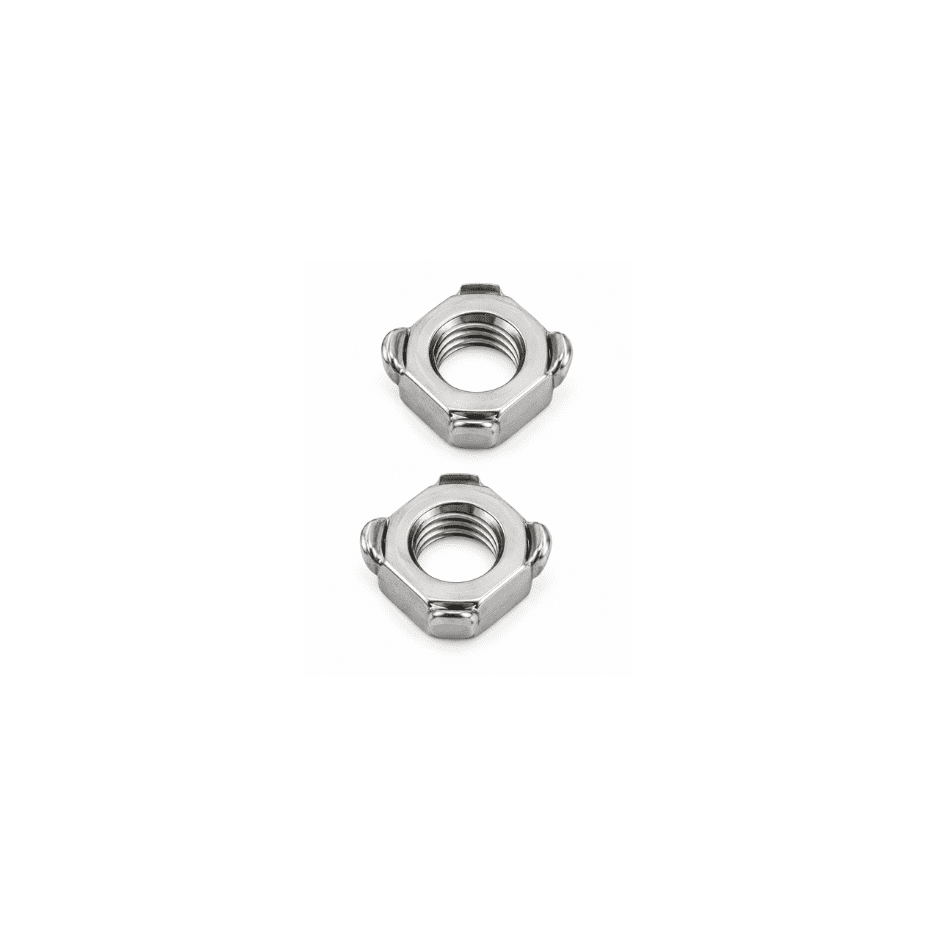
AM Steel Square Weld Nuts are four-sided nuts engineered to be welded directly onto sheet metal or a fabricated component, creating a permanent, captive internal thread on a surface that can’t easily be tapped – such as thin sheet or the blind side of a panel. Manufactured under the AM Steel brand to DIN 928, these nuts (widely known as projection weld nuts or square weldnuts) typically carry small raised projections (weld bumps) on the seating face; under a resistance (spot) welding electrode, these projections concentrate the current, melt, and fuse the nut cleanly to the workpiece in a fast, repeatable operation.
Because the nut becomes a fixed part of the component, AM Steel square weld nuts are well suited to high-volume manufacturing where a threaded fixing point must be built into a panel – automotive body and chassis assembly, sheet-metal fabrication, electrical enclosures and cabinets, appliances, and general fabricated products. The square shape gives a large, stable seating footprint and resists rotation once welded, while the projections ensure consistent weld quality and alignment. Once fitted, the weld nut accepts a standard bolt or screw from the accessible side, giving a strong, reusable threaded connection with nothing loose to drop or misalign during assembly. AM Steel square weld nuts are supplied in weldable low-carbon steel (plain or lightly coated for welding) for general fabrication, and in stainless steel (A2/304 and A4/316) where corrosion resistance is required – noting that the seating face is typically left uncoated so the weld can form correctly.
Whether you’re building automotive assemblies, fabricating sheet-metal panels, manufacturing enclosures and cabinets, or handling any product that needs a built-in threaded fixing point, AM Steel square weld nuts deliver the permanent captive thread, consistent weldability, and reliable quality needed for production fabrication. As with all AM Steel products, this square weld nut is available in a range of metric sizes (typically M4 to M12 per DIN 928), in weldable steel and stainless steel to suit both industrial-grade and everyday fabrication needs.
Key features:
- Four-sided nut welded permanently to a component to create a captive threaded boss
- Weld projections concentrate current for clean, fast, repeatable resistance (spot) welding
- Large square footprint gives a stable seat and resists rotation once welded
- Provides a threaded fixing point on thin sheet or blind panels that can’t be tapped
- Manufactured to DIN 928 dimensional standards
- Available in weldable low-carbon steel and stainless steel (A2/304, A4/316)
- Backed by the quality assurance of AM Steel
Ideal For
AM Steel Square Weld Nuts are ideal for:
- Automotive body, chassis, and component assembly needing built-in threaded fixing points
- Sheet-metal fabricators creating captive threads on thin panels that can’t be tapped
- Electrical enclosure, cabinet, and switchgear manufacturing requiring blind-side threaded bosses
- Appliance and general product manufacturing with high-volume, repeatable weld-in fixings
- Fabrication where a strong, permanent, rotation-resistant threaded connection is required
Choosing the Right Square Weld Nut
Selecting the correct square weld nut from the AM Steel range depends on several factors:
- Material Compatibility – Match the weld nut material to the base component (weldable low-carbon steel to steel, stainless to stainless) for a sound weld and to avoid galvanic issues.
- Projection Type – Confirm the projection arrangement suits your resistance-welding setup for consistent, properly fused welds.
- Thread Size – Choose the internal thread (e.g. M4 to M12) to match the bolt or screw that will be fitted after welding.
- Base Thickness – Ensure the sheet or component thickness suits the weld nut and welding parameters for a strong, distortion-free joint.
- Coating – Leave the weld/seating face uncoated for a clean weld; where corrosion resistance is needed, choose stainless or apply protective coating after welding rather than before.
- Weld Method – Confirm the nut suits your process – projection/resistance welding is standard, but verify parameters for your equipment and production volume.
Strategies to Choose the Right Product
- Match weld nut material to the base metal – Weld low-carbon steel nuts to steel and stainless to stainless for a sound fusion and to avoid galvanic corrosion in service.
- Keep the weld face uncoated – Projections and the seating face should be clean and uncoated so the resistance weld forms correctly; apply any protective finish after welding.
- Confirm your welding parameters – Set current, force, and timing to suit the projections and base thickness for consistent, repeatable welds in production.
- Choose the thread to suit the fixing – Select the internal thread size to match the bolt or screw that will be fitted from the accessible side after welding.
- Prioritize certified standards – Look for DIN 928 compliance for guaranteed dimensional and projection consistency.
- Consider bulk supply for production – Weld nuts are typically used in high-volume manufacturing; bulk packs suit production runs, smaller quantities suit prototyping and repairs.
Mechanical Properties
AM Steel Square Weld Nuts are manufactured to meet recognized mechanical and dimensional standards, ensuring reliability across automotive, sheet-metal, and enclosure fabrication applications:
| Property | Specification |
|---|---|
| Material Grades | Weldable Low-Carbon Steel, Stainless Steel (A2/304, A4/316) |
| Governing Standard | DIN 928 (Square Weld Nuts) |
| Shape | Four-sided (square) with weld projections on the seating face |
| Fixing Method | Resistance / projection (spot) welded permanently to the component |
| Thread Type | Internal metric thread (coarse) per ISO 261 / ISO 262 |
| Size Range | M4 to M12 (metric) |
| Weld Feature | Raised projections that concentrate welding current for clean fusion |
| Corrosion Resistance | Low (plain steel, pre-weld) to high (A2/A4 stainless steel or post-weld coating) |
| Common Alternate Names | Projection weld nut, square weldnut, weld-in nut |
| Typical Applications | Automotive assembly, sheet-metal fabrication, enclosures, appliances |
| Surface Finish | Plain / uncoated weld face; stainless passivated; coated after welding if required |
These mechanical ratings confirm that AM Steel square weld nuts deliver a permanent, captive threaded boss suited to automotive, sheet-metal, and enclosure fabrication – match the nut material to the base metal and keep the weld face uncoated for a clean, consistent weld.
Frequently Asked Questions (FAQs)
1. What is a square weld nut used for?
A square weld nut is welded permanently onto a metal component to create a strong, captive threaded fixing point – used where a tapped hole isn’t practical, such as on thin sheet or the blind side of a panel, in automotive and sheet-metal fabrication.
2. How is a square weld nut attached?
It’s attached by resistance (projection) welding – small raised projections on the nut’s seating face concentrate the welding current under an electrode, melting and fusing the nut cleanly to the workpiece in a fast, repeatable operation.
3. What are the projections on a weld nut for?
The projections (weld bumps) focus the resistance-welding current to a small area so it melts first, ensuring a consistent, properly fused weld and correct alignment of the nut to the component.
4. Why choose a square weld nut over a hex or round weld nut?
A square weld nut has a large, stable seating footprint that resists rotation once welded and provides a wide bearing area; the shape suits panels and brackets where a broad, secure weld base is preferred.
5. Are AM Steel square weld nuts different from generic ones?
AM Steel square weld nuts are manufactured and quality-tested under the AM Steel brand, ensuring consistent thread quality, projection geometry, and dimensions across every batch, per DIN 928.
6. What material should a weld nut be?
The weld nut should match the base component – weldable low-carbon steel for steel parts, stainless for stainless – so the weld fuses correctly and the joint avoids galvanic corrosion in service.
7. Should weld nuts be coated or plated?
The weld face should be left clean and uncoated so the resistance weld forms properly; where corrosion protection is needed, use stainless steel or apply any plating or coating after welding, not before.
8. What sizes do square weld nuts come in?
AM Steel square weld nuts are available in a range of sizes, typically M4 to M12 in metric, per DIN 928.
9. What bolt do I use with a square weld nut?
Once welded, the nut accepts a standard metric bolt or screw of the matching thread size, fitted from the accessible side to give a strong, reusable threaded connection.
10. Are square weld nuts corrosion-resistant?
Plain steel weld nuts have limited corrosion resistance before finishing; for corrosion protection, choose stainless steel (A2/304 or A4/316) versions or apply a protective coating to the assembly after welding.
11. Can square weld nuts be used on the blind side of a panel?
Yes – a key advantage is providing a threaded fixing point on the blind or inaccessible side of a panel, so a bolt can be fitted from the open side into the captive welded nut.
12. What welding method is used for square weld nuts?
Resistance (projection/spot) welding is the standard method, using the nut’s projections to achieve a clean, fast, repeatable weld – verify current, force, and timing for your equipment and base thickness.
13. What’s the difference between A2 and A4 stainless steel square weld nuts?
A2 (304) stainless offers good general corrosion resistance for most use, while A4 (316), considered marine-grade, provides superior resistance to chlorides and coastal or chemical environments.
Reviews
There are no reviews yet.