


Description
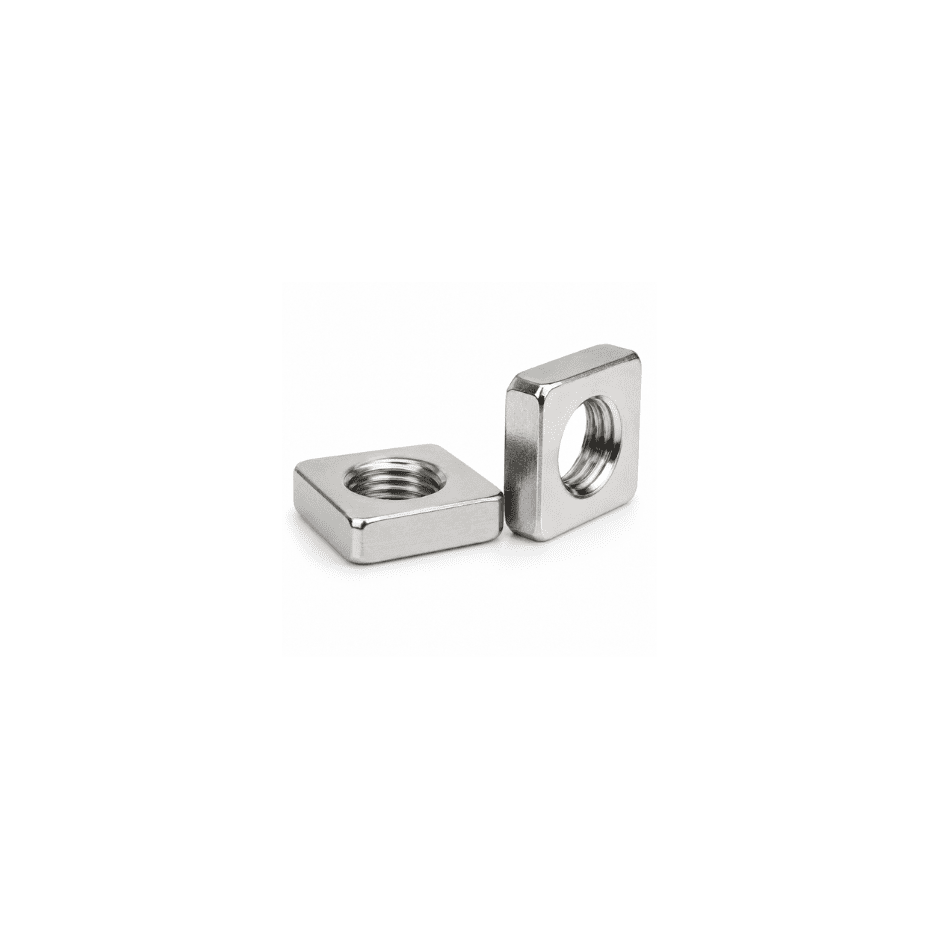
AM Steel Square Nuts are four-sided (square) internally threaded fasteners whose larger, flat bearing edges give them a distinct advantage over hex nuts: the flat sides seat neatly into a channel, slot, or recess, or bear against a flat surface, so the nut resists rotation and can be held or trapped in place while the bolt is driven from the other side. Manufactured under the AM Steel brand to DIN 557 (with thinner sheet-metal versions to DIN 562), these nuts are a traditional and enduring choice in framing, channel, and woodworking applications where a hex nut would need a second spanner to stop it spinning.
Because the square shape locks against a flat or into a channel, AM Steel square nuts are well suited to strut channel and framing systems (such as Unistrut-style channel), where the nut slides into the channel and turns to grip its lips; to woodworking and timber connections, where the flat edge beds against the timber to resist rotation; and to sign, fabrication, and machinery assembly where a captive, non-turning nut speeds installation. The larger bearing surface of a square nut also spreads clamping load over a wider area than an equivalent hex nut. AM Steel square nuts are available in carbon steel (zinc-plated or hot-dip galvanized) for general and structural work, and in stainless steel (A2/304 and A4/316, the latter considered marine-grade) for outdoor, wet, and coastal environments where corrosion resistance is critical.
Whether you’re building with strut channel and framing systems, making timber and woodworking connections, assembling signage and fabricated structures, or handling any joint where a nut must resist turning or be held captive, AM Steel square nuts deliver the anti-rotation grip, wide bearing surface, and consistent quality needed for channel, framing, and general assembly. As with all AM Steel products, this square nut is available in a range of metric sizes (typically M3 to M16 per DIN 557), in multiple materials and finishes to suit both industrial-grade and everyday fastening needs.
Key features:
- Four flat edges that seat into a channel or against a flat surface to resist rotation
- Can be held or trapped captive while the bolt is tightened, often without a second tool
- Larger bearing surface spreads clamping load over a wider area than a hex nut
- Manufactured to DIN 557 (standard) / DIN 562 (thin sheet-metal) dimensional standards
- Widely used in strut channel and framing systems
- Available in carbon steel (zinc-plated, galvanized) and stainless steel (A2/304, A4/316)
- Backed by the quality assurance of AM Steel
Ideal For
AM Steel Square Nuts are ideal for:
- Strut channel and framing systems where the nut slides into the channel and grips against its lips
- Woodworking and timber connections where the flat edge beds against the wood to resist rotation
- Signage, fabrication, and structural assembly needing a captive, non-turning nut
- Machinery and equipment builds where a held or trapped nut speeds installation
- General assembly wherever a nut must resist turning or sit flush against a flat surface
Choosing the Right Square Nut
Selecting the correct square nut from the AM Steel range depends on several factors:
- Material – Stainless steel (A2/304 or A4/316) for outdoor, wet, or corrosion-prone applications; carbon steel (zinc-plated or galvanized) for general and structural work.
- Type / Thickness – Standard square nuts (DIN 557) for general fastening; thin square nuts (DIN 562) for sheet-metal and low-clearance applications.
- Channel Compatibility – For strut channel systems, confirm the nut size and profile suit the specific channel so it seats and grips correctly against the lips.
- Thread Size & Pitch – Choose the diameter and pitch (coarse or fine) to match the mating bolt, screw, or threaded rod exactly.
- Bearing Requirement – Use the wider square bearing face where load must be spread over a larger area, such as against timber or soft materials.
- Finish – Zinc-plated for basic indoor protection, hot-dip galvanized for outdoor durability, stainless for maximum corrosion resistance.
Strategies to Choose the Right Product
- Use square nuts to resist rotation – Their flat edges seat against a surface or into a channel so the nut is held from turning, often removing the need for a second spanner during tightening.
- Match the nut to your channel system – For strut/framing channel, confirm the square nut suits the channel profile so it locks against the lips and grips reliably.
- Choose thickness for the job – Use standard DIN 557 nuts for general work and thin DIN 562 nuts where sheet metal or limited clearance calls for a lower profile.
- Match material to environment – Use stainless steel (A2/304 or A4/316) for outdoor, wet, or coastal work; zinc-plated or galvanized steel for general dry or exterior construction.
- Prioritize certified standards – Look for DIN 557 / DIN 562 compliance for guaranteed dimensional consistency.
- Match thread size and pitch exactly – Confirm both diameter and coarse/fine pitch against the mating bolt for correct engagement.
Mechanical Properties
AM Steel Square Nuts are manufactured to meet recognized mechanical and dimensional standards, ensuring reliability across channel, framing, woodworking, and general assembly applications:
| Property | Specification |
|---|---|
| Material Grades | Carbon Steel, Stainless Steel (A2/304, A4/316) |
| Governing Standard | DIN 557 (square nuts); DIN 562 (thin square nuts for sheet metal) |
| Shape | Four-sided (square) with flat anti-rotation edges |
| Drive / Engagement | Held against a flat or in a channel; spanner where required |
| Thread Type | Internal metric thread (coarse or fine) per ISO 261 / ISO 262 |
| Size Range | M3 to M16 (metric) |
| Bearing Surface | Larger than an equivalent hex nut, spreading clamping load |
| Corrosion Resistance | Moderate (zinc-plated steel) to high (hot-dip galvanized, A2/A4 stainless steel) |
| Common Alternate Names | Four-sided nut, channel nut, framing nut |
| Typical Applications | Strut channel, framing systems, woodworking, signage, fabrication |
| Surface Finish | Zinc-plated, hot-dip galvanized, plain or passivated stainless steel |
These mechanical ratings confirm that AM Steel square nuts deliver reliable anti-rotation fastening and a wide bearing surface suited to channel, framing, woodworking, and general assembly applications – seat the flat edges against a surface or channel to hold the nut from turning during tightening.
Frequently Asked Questions (FAQs)
1. What is a square nut used for?
A square nut is used where a nut must resist rotation or be held captive – in strut channel and framing systems, woodworking, and fabrication – its four flat edges seating against a surface or into a channel so the bolt can be tightened without the nut spinning.
2. Why use a square nut instead of a hex nut?
A square nut’s flat edges seat against a flat surface or into a channel to resist turning, so it can be held or trapped without a second spanner, and its larger bearing face spreads clamping load over a wider area than a hex nut.
3. Are AM Steel square nuts different from generic ones?
AM Steel square nuts are manufactured and quality-tested under the AM Steel brand, ensuring consistent thread quality, across-flats dimensions, and finish across every batch, per DIN 557 / DIN 562.
4. What’s the difference between DIN 557 and DIN 562 square nuts?
DIN 557 covers standard-thickness square nuts for general fastening, while DIN 562 covers thin square nuts designed for sheet-metal and low-clearance applications where a lower profile is needed.
5. Are square nuts used with strut channel?
Yes – square and channel nuts are a mainstay of strut/framing systems, sliding into the channel and turning to grip against its lips; confirm the nut suits your specific channel profile for a reliable lock.
6. What sizes do square nuts come in?
AM Steel square nuts are available in a range of sizes, typically M3 to M16 in metric, per DIN 557.
7. Are square nuts corrosion-resistant?
Yes, especially AM Steel stainless steel versions (A2/304 or A4/316), which resist rust in outdoor, wet, or coastal environments; hot-dip galvanized and zinc-plated steel offer protection for general and dry conditions.
8. Can a square nut be held without a spanner?
Yes – that’s a key advantage; when its flat edge beds against a surface or sits in a channel, the nut is held from turning, so the bolt can be tightened from the other side without a second tool.
9. Do square nuts spread load better than hex nuts?
Generally yes — a square nut of the same thread size has a larger flat bearing face than a hex nut, spreading the clamping load over a wider area, which is useful against timber or softer materials.
10. Can square nuts be used in woodworking?
Yes – square nuts have a long history in timber connections, where the flat edge beds into or against the wood to resist rotation, often held captive in a recess while the bolt is tightened.
11. Can square nuts be reused?
Yes, in most applications they can be removed and reused provided the threads are undamaged and clean; nuts with damaged or corroded threads should be replaced.
12. What bolt do I use with a square nut?
A square nut mates with a standard metric bolt, screw, or threaded rod of the matching diameter and pitch – the same fixings a hex nut would use.
13. What’s the difference between A2 and A4 stainless steel square nuts?
A2 (304) stainless offers good general corrosion resistance for most indoor and outdoor use, while A4 (316), considered marine-grade, provides superior resistance to chlorides and coastal or chemical environments.
Reviews
There are no reviews yet.