


Description
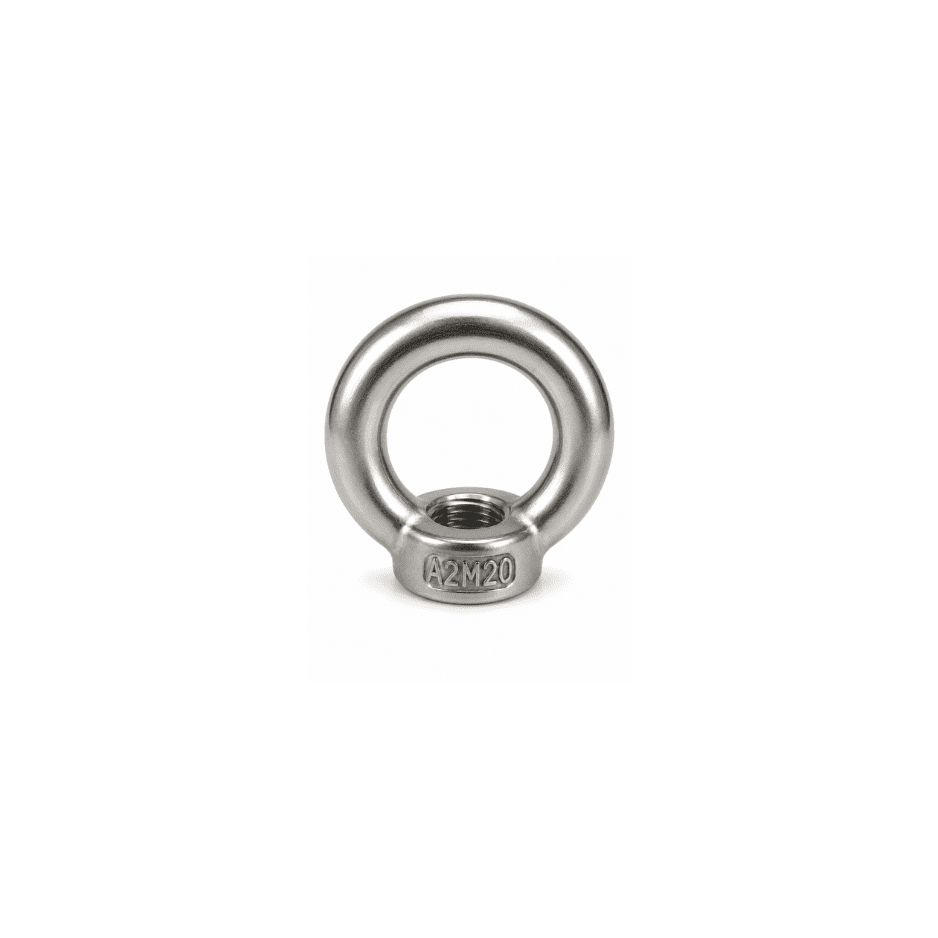
AM Steel Eye Nuts are forged nuts featuring a closed loop or ring (the “eye”) above a standard internal thread, creating a ready-made attachment point that screws onto a bolt, stud, or threaded rod. Manufactured under the AM Steel brand to DIN 582, these fittings (widely known as ring nuts or lifting eye nuts) provide a strong, versatile connection for hooks, shackles, ropes, wire, chains, and cables – the counterpart to the eye bolt, used where the threaded end is a stud or bolt rather than a tapped hole.
Because the forged ring is designed to take a line or lifting device, AM Steel eye nuts are widely used for lifting and rigging, load securing, towing, guy-wire and cable anchoring, and general attachment of springs, pulleys, and tensioners. Forging (rather than casting or bending from bar) gives the eye its strength and load integrity, and lifting-rated versions carry a stated working load limit (WLL) that must be observed and matched to the load and angle of pull. For overhead lifting, the direction of loading matters: eye nuts are strongest when loaded in line with the eye and are de-rated for angular loading, so correct orientation and rigging practice are essential. AM Steel eye nuts are available in forged carbon steel (zinc-plated or galvanized) for general and industrial use, and in stainless steel (A2/304 and A4/316, the latter considered marine-grade) for outdoor, wet, and marine environments where corrosion resistance is critical.
Whether you’re rigging a lifting point, securing or towing a load, anchoring guy wires and cables, or attaching springs, pulleys, and tensioners, AM Steel eye nuts deliver the forged strength, secure attachment ring, and consistent quality needed for load-bearing connection points. As with all AM Steel products, this eye nut is available in a range of metric sizes (typically M6 to M36 per DIN 582), in multiple materials and finishes to suit both industrial-grade and everyday attachment needs.
Key features:
- Forged looped ring (eye) provides a secure attachment point for hooks, shackles, ropes, and chains
- Internal thread screws onto a standard bolt, stud, or threaded rod
- Forged construction for strength and load integrity in lifting and rigging use
- Lifting-rated versions carry a stated working load limit (WLL) to be matched to the load
- Manufactured to DIN 582 dimensional standards
- Available in forged carbon steel (zinc-plated, galvanized) and stainless steel (A2/304, A4/316)
- Backed by the quality assurance of AM Steel
Ideal For
AM Steel Eye Nuts are ideal for:
- Lifting and rigging applications needing a threaded attachment point for hooks, shackles, and slings
- Load securing and towing where a line, chain, or cable connects to a bolt or stud
- Guy-wire, cable, and tensioner anchoring on structures, masts, and equipment
- Spring, pulley, and block attachment in mechanical and workshop assemblies
- General industrial fixing wherever a strong looped connection point is required on a threaded end
Choosing the Right Eye Nut
Selecting the correct eye nut from the AM Steel range depends on several factors:
- Application — Lifting vs Non-Lifting – For overhead lifting, use a lifting-rated eye nut with a stated working load limit and observe its rating; for non-lifting attachment (guy wires, springs), a general-purpose eye nut may suffice.
- Working Load Limit (WLL) – Match the WLL to the load, including a safety margin, and account for de-rating when the pull is at an angle rather than in line.
- Material – Stainless steel (A2/304 or A4/316) for outdoor, wet, or marine applications; forged carbon steel (galvanized) for general and industrial use.
- Direction of Load – Eye nuts are strongest loaded in line with the eye; confirm the rigging keeps the load within the rated direction and angle.
- Thread Size & Pitch – Choose the diameter and pitch to match the mating bolt, stud, or threaded rod exactly.
- Certification – For lifting, prioritize products with documented load ratings and compliance appropriate to the lifting regulations in your region.
Strategies to Choose the Right Product
- Never exceed the working load limit – For any lifting use, select an eye nut rated above the load with an appropriate safety factor, and treat the WLL as an absolute limit.
- Account for angle of pull – Eye nuts lose capacity when loaded at an angle; keep the load in line with the eye where possible, and de-rate according to the rigging angle.
- Use lifting-rated fittings for overhead loads – For anything lifted overhead, choose a certified lifting eye nut, not a general-purpose one, and follow safe rigging practice.
- Match material to environment – Use stainless steel (A2/304 or A4/316) for outdoor, wet, or marine work; galvanized forged steel for general industrial use.
- Inspect before each lift – Check the eye and thread for wear, deformation, or damage before use; retire any fitting showing cracks, stretch, or thread damage.
- Confirm thread compatibility – Match the thread size and pitch to the bolt or stud so the eye nut seats fully and bears the load correctly.
Mechanical Properties
AM Steel Eye Nuts are manufactured to meet recognized mechanical and dimensional standards, ensuring reliability across lifting, rigging, anchoring, and attachment applications:
| Property | Specification |
|---|---|
| Material Grades | Forged Carbon Steel, Stainless Steel (A2/304, A4/316) |
| Governing Standard | DIN 582 (Lifting Eye Nuts) |
| Shape | Forged closed ring (eye) above an internally threaded body |
| Construction | Forged for load integrity |
| Thread Type | Internal metric thread (coarse) per ISO 261 / ISO 262 |
| Size Range | M6 to M36 (metric) |
| Load Rating | Working load limit (WLL) stated per size on lifting-rated versions |
| Load Direction | Strongest in line with the eye; de-rated for angular loading |
| Corrosion Resistance | Moderate (zinc-plated / galvanized steel) to high (A2/A4 stainless steel) |
| Common Alternate Names | Ring nut, lifting eye nut, threaded eye nut |
| Typical Applications | Lifting, rigging, towing, guy-wire and cable anchoring, spring/pulley attachment |
| Surface Finish | Zinc-plated, hot-dip galvanized, plain or passivated stainless steel |
These mechanical ratings confirm that AM Steel eye nuts deliver forged, load-bearing attachment points suited to lifting, rigging, and anchoring applications – always observe the working load limit, keep the load in line with the eye, and de-rate for angular loading for safe use.
Frequently Asked Questions (FAQs)
1. What is an eye nut used for?
An eye nut provides a threaded attachment point with a looped ring for connecting hooks, shackles, ropes, chains, or cables – used in lifting, rigging, towing, and anchoring wherever a line or lifting device must attach to a bolt, stud, or threaded rod.
2. What’s the difference between an eye nut and an eye bolt?
An eye nut has an internal thread and screws onto a bolt, stud, or threaded rod, while an eye bolt has an external threaded shank that screws into a tapped hole – both provide a looped attachment point, chosen to suit the threaded end available.
3. Are AM Steel eye nuts different from generic ones?
AM Steel eye nuts are manufactured and quality-tested under the AM Steel brand, ensuring consistent forging quality, thread accuracy, and finish across every batch, per DIN 582.
4. Can eye nuts be used for overhead lifting?
Lifting-rated eye nuts can be used for overhead lifting when their working load limit is observed and correct rigging practice is followed; always use a certified lifting fitting, never exceed the rating, and de-rate for angular loading.
5. What is the working load limit (WLL)?
The working load limit is the maximum load the eye nut is rated to bear in normal use with a built-in safety factor; it must be matched to the load and treated as an absolute limit, with de-rating applied for angled pulls.
6. Why does the direction of load matter?
Eye nuts are strongest when loaded in line with the eye and lose capacity when the pull is at an angle; loading off-axis can significantly reduce the safe load, so rigging must keep the load within the rated direction.
7. What sizes do eye nuts come in?
AM Steel eye nuts are available in a range of sizes, typically M6 to M36 in metric, per DIN 582, with load ratings stated per size on lifting-rated versions.
8. Are eye nuts corrosion-resistant?
Yes, especially AM Steel stainless steel versions (A2/304 or A4/316), which resist rust in outdoor, wet, or marine environments; hot-dip galvanized forged steel also offers strong outdoor protection.
9. Why are eye nuts forged rather than cast or bent?
Forging gives the eye its strength and load integrity, producing a consistent grain structure that resists deformation under load – important for lifting fittings, where a bent-bar or cast ring could be weaker.
10. Should I inspect eye nuts before use?
Yes – before each lift, check the eye and thread for wear, cracks, stretch, or deformation, and retire any fitting showing damage; regular inspection is essential for any load-bearing lifting fitting.
11. What tools do I need to fit an eye nut?
An eye nut is threaded on by hand onto the matching bolt or stud and seated fully; for load use it should be tightened down properly against its bearing face so the eye is correctly oriented to the direction of pull.
12. Can eye nuts be used for anchoring guy wires or springs?
Yes – beyond lifting, eye nuts are widely used as anchoring and attachment points for guy wires, cables, springs, pulleys, and tensioners on structures and equipment.
13. What’s the difference between A2 and A4 stainless steel eye nuts?
A2 (304) stainless offers good general corrosion resistance for most outdoor use, while A4 (316), considered marine-grade, provides superior resistance to chlorides and coastal or marine environments.
Reviews
There are no reviews yet.