


Description
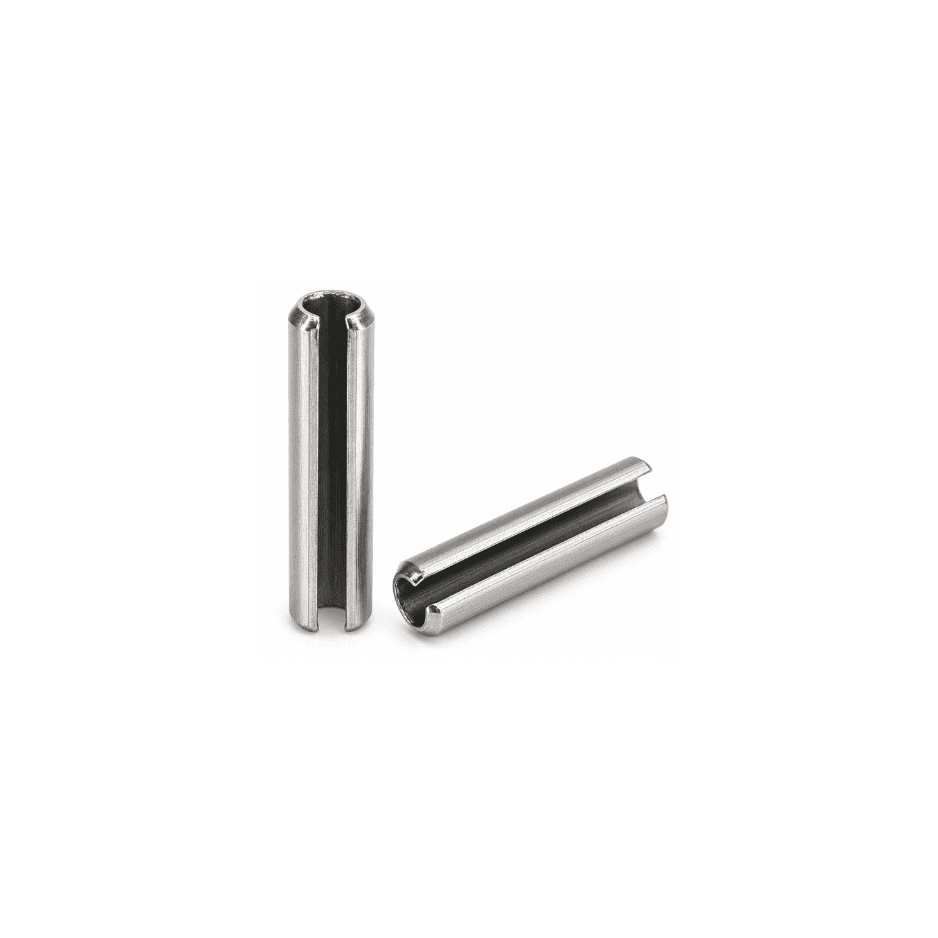
AM Steel Spring Dowel Pins are hollow, cylindrical pins with a single longitudinal slot running the full length of the pin, giving the design its “split” or “slotted” construction. Manufactured under the AM Steel brand to DIN 1481 (equivalent to ISO 8752), the pin’s resting diameter is intentionally slightly larger than the hole it’s designed for – as it’s driven or pressed into the hole, the slot compresses, and the pin’s spring action then exerts continuous, uniform outward pressure against the hole wall, creating a secure, self-locking friction fit without needing a precisely reamed or toleranced hole, unlike a solid dowel pin.
This spring action gives slotted spring pins (also widely known as roll pins) a genuine practical advantage over solid dowel pins: because they don’t require a tightly toleranced hole to function, they’re generally easier and less costly to install, and they tolerate a reasonable range of hole diameter variation while still maintaining a secure fit. It’s worth distinguishing slotted spring pins (DIN 1481/ISO 8752, a single slot along the pin’s length) from coiled spring pins (a separate design, wound from spring steel in two or more coils, covered under standards like ISO 8748/8750) – while both are broadly called “spring pins,” coiled pins offer a different combination of flexibility and load capacity and are specified separately in more demanding applications.
AM Steel spring dowel pins are manufactured in spring steel (which won’t deform under stress or vibration but is best suited to dry environments since moisture causes rust) and stainless steel (301 or 18-8/304 for general wet or outdoor use), suited to shaft and axle connections, hinge pins, and general assembly wherever side loads and rotational friction need to be resisted. As with all AM Steel products, this spring dowel pin is available in metric sizing (typically M1 to M40, lengths from 4mm to 200mm, per DIN 1481/ISO 8752), in multiple materials and finishes to suit both industrial-grade and everyday fastening needs.
Key features:
- Hollow, split (slotted) design with a single longitudinal slot for spring action
- Manufactured to DIN 1481 / ISO 8752 (equivalent standards)
- Doesn’t require a precisely reamed hole, unlike a solid dowel pin
- Withstands side loads and rotational friction; ideal for shaft and axle connections
- Available in spring steel and stainless steel (301, 18-8/304)
- Backed by the quality assurance of AM Steel
Ideal For
AM Steel Spring Dowel Pins are ideal for:
- Machine and equipment assemblers securing shaft and axle connections against side loads and rotational friction
- Hinge and pivot mechanism builders needing an easy-to-install, secure pin without a precisely reamed hole
- Automotive and heavy machinery technicians using spring pins in power transmission components
- General fabrication and repair work wherever a fast, tolerant-fit alternative to a solid dowel pin is needed
- Wet or outdoor equipment applications using stainless steel spring pins for corrosion resistance
Choosing the Right Spring Dowel Pin
Selecting the correct spring dowel pin from the AM Steel range depends on several factors:
- Pin Type – Slotted (single-slot) spring pin (DIN 1481/ISO 8752) for general use; coiled spring pin (a separate design) where greater flexibility or a different load profile is specifically required.
- Material – Spring steel for maximum strength in dry environments; stainless steel (301 or 18-8/304) for wet, outdoor, or corrosive environments.
- Diameter – Choose a pin with a resting diameter appropriately larger than your hole diameter, per DIN 1481/ISO 8752 sizing tables – precise hole reaming isn’t required.
- Length – Match the pin length to the shaft, hinge, or component thickness being secured.
- Load Type – Confirm the spring pin’s shear and side-load capacity is adequate for the specific shaft, axle, or hinge application.
- Installation Method – Confirm whether hand-driving (hammer/punch) or a pressing tool is appropriate for the pin size and application.
Strategies to Choose the Right Product
- Choose spring pins where hole tolerance is less critical – Use slotted spring pins over solid dowel pins where a precisely reamed hole isn’t practical or cost-effective for the application.
- Match material to environment – Use stainless steel (301 or 18-8/304) for wet, outdoor, or corrosive environments; spring steel for maximum strength in dry, indoor conditions.
- Distinguish slotted from coiled spring pins – Confirm whether your application specifically calls for a slotted (DIN 1481/ISO 8752) or coiled spring pin design before ordering, since they are different products with different performance characteristics.
- Size for secure interference fit – Select the pin diameter according to standard DIN 1481/ISO 8752 sizing relative to your hole diameter, rather than assuming a one-size-fits-all fit.
- Buy in matched sets – Purchase spring pins in consistent diameter and length across a production run for repeatable results.
- Consider bulk vs. individual packs – Bulk packs suit machinery or automotive production runs; smaller packs suit repairs or small assemblies.
Mechanical Properties
AM Steel Spring Dowel Pins are manufactured to meet recognized mechanical and dimensional standards, ensuring reliability across shaft, hinge, and general machine assembly applications:
| Property | Specification |
|---|---|
| Material Grades | Spring Steel, Stainless Steel (301, 18-8/304, A2) |
| Governing Standards | DIN 1481, ISO 8752 (equivalent) |
| Design | Hollow, cylindrical pin with a single longitudinal slot |
| Function | Compresses on insertion; exerts continuous outward spring pressure for a self-locking friction fit |
| Related Standard | Coiled spring pins (a separate design, ISO 8748/8750) — not directly interchangeable with slotted spring pins |
| Size Range | Approximately M1 to M40 (metric diameter); lengths from 4mm to 200mm |
| Hole Tolerance Requirement | Does not require a precisely reamed hole, unlike solid dowel pins |
| Corrosion Resistance | Low (spring steel, rusts in moisture) to high (301, 18-8/304, A2 stainless steel) |
| Surface Finish | Black, zinc-plated, phosphated (spring steel); plain/passivated (stainless steel) |
These mechanical ratings confirm that AM Steel spring dowel pins provide a reliable, tolerant-fit alternative to solid dowel pins – always distinguish between slotted and coiled spring pin designs before specifying for your application.
Frequently Asked Questions (FAQs)
1. What is a spring dowel pin used for? A spring dowel pin (or roll pin) is used to secure and align shaft and axle connections, hinges, and general machine components, using its spring action to create a secure, self-locking friction fit inside a hole.
2. What’s the difference between a spring dowel pin and a solid dowel pin? A spring dowel pin is hollow and slotted, compressing slightly on insertion to create spring pressure and doesn’t require a precisely reamed hole, while a solid dowel pin is a solid cylinder requiring a tightly toleranced hole for an accurate press or slip fit.
3. Are AM Steel spring dowel pins different from generic roll pins? AM Steel spring dowel pins are manufactured and quality-tested under the AM Steel brand, ensuring consistent slot geometry, spring tension, and dimensional accuracy across every batch, per DIN 1481/ISO 8752.
4. What’s the difference between a slotted spring pin and a coiled spring pin? A slotted spring pin (DIN 1481/ISO 8752) has a single longitudinal slot along its length, while a coiled spring pin is wound from spring steel in two or more coils under a separate standard (such as ISO 8748/8750) – both are broadly called “spring pins” but have different flexibility and load characteristics, and are not directly interchangeable.
5. Are spring dowel pins corrosion-resistant? Yes, especially AM Steel stainless steel spring dowel pins (301 or 18-8/304), which resist rust in wet or outdoor environments; spring steel versions are stronger but best suited to dry conditions since moisture causes rust.
6. What sizes do spring dowel pins come in? AM Steel spring dowel pins are available in a range of sizes, typically M1 to M40 in diameter, with lengths from 4mm to 200mm, per DIN 1481/ISO 8752.
7. Do I need a precisely reamed hole for a spring dowel pin? No – unlike a solid dowel pin, a spring dowel pin’s slotted design compresses slightly on insertion, so it tolerates a reasonable range of hole diameter variation while still maintaining a secure fit.
8. What tools do I need to install a spring dowel pin? A hammer and punch, or a pressing tool, is typically used to drive or press the pin into its hole, depending on the pin size and application.
9. Can spring dowel pins be removed and reused? Yes, spring dowel pins are generally designed for relatively easy insertion and removal, making them a practical choice for components that may need occasional disassembly, though repeated removal can gradually reduce spring tension over time.
10. What’s the difference between spring steel and stainless steel spring dowel pins? Spring steel pins offer higher strength and won’t deform under stress or vibration but are prone to rust in moist environments, while stainless steel pins resist corrosion in wet or outdoor conditions but generally withstand slightly less extreme stress and vibration than spring steel.
11. What loads can a spring dowel pin handle? Spring dowel pins are designed to withstand side loads and rotational friction, making them well suited to shaft, axle, and hinge applications, though load capacity varies by pin diameter and material – larger diameters and spring steel offer higher capacity.
12. What industries commonly use spring dowel pins? Common applications include heavy machinery, automotive components, aerospace equipment, household furniture, and electrical connectors, wherever a secure, easy-to-install pin connection is needed.
13. Should I choose a slotted or coiled spring pin for my application? This depends on your specific load, flexibility, and installation requirements – slotted spring pins (DIN 1481/ISO 8752) are the more commonly available general-purpose option, while coiled spring pins may be specified separately where their particular flexibility or load profile is required; consult your application’s engineering specification if unsure.
Reviews
There are no reviews yet.