


Description
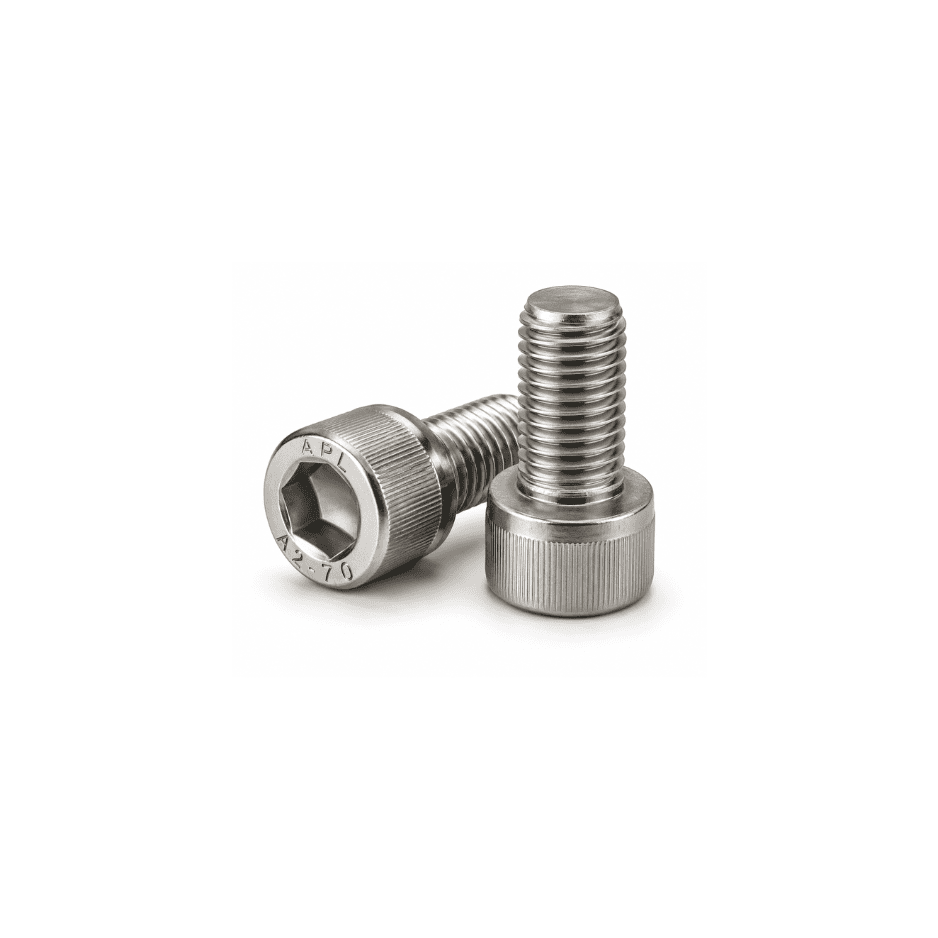
AM Steel Socket Head Cap Screws feature a cylindrical head with a flat underside and an internal hexagonal drive, commonly referred to as an Allen socket. This design allows a hex key or socket driver to apply high tightening torque directly along the fastener’s axis – without the cam-out risk of external drives – even in confined spaces where a wrench or standard hex head bolt won’t fit. Manufactured under the AM Steel brand to ISO 4762 (which has largely superseded the original DIN 912 standard, with parts from either fully interchangeable) and ASME B18.3 for inch-series sizing, these socket head cap screws are a staple fastener across precision engineering, automation equipment, and mold-making.
AM Steel socket head cap screws are available in property class 8.8, 10.9, and 12.9 alloy steel (per ASTM A574/A574M), offering strength levels well above standard hex bolts of the same diameter – Class 12.9 alloy steel provides a minimum tensile strength around 1200 MPa, making it a preferred choice for high clamping force in non-corrosive environments. For applications requiring corrosion resistance, AM Steel also offers stainless steel socket head cap screws in A2 and A4 grades, including A4-80 (approximately 800 MPa tensile strength) for marine, chemical processing, and other corrosive environments where the modest reduction in strength versus alloy steel is an acceptable trade-off.
Whether you’re assembling precision machine tools, automotive components, mold and die tooling, or any application needing a strong, flush-fitting connection in tight quarters, AM Steel socket head cap screws provide dependable, repeatable performance. As with all AM Steel products, this socket head cap screw is available in metric sizing (M1.6 to M64 per ISO 4762) and inch sizing (per ASME B18.3), in multiple grades and finishes to suit both industrial-grade and precision fastening needs.
Key features:
- Cylindrical head with flat underside for a clean, flush, evenly-loaded seat
- Internal hex (Allen) socket drive for high torque in confined spaces
- Available in property class 8.8, 10.9, and 12.9 alloy steel
- Stainless steel socket head cap screws available in A2 and A4 (including A4-80) grades
- Manufactured to ISO 4762/DIN 912 and ASME B18.3 dimensional standards
- Backed by the quality assurance of AM Steel
Ideal For
AM Steel Socket Head Cap Screws are ideal for:
- Precision machinery and automation equipment builders needing high-torque fastening in confined spaces
- Mold and die makers requiring a flush-fitting, high-strength fastener for tooling assembly
- Automotive and aerospace fabricators assembling components under demanding strength and space constraints
- Machine tool and robotics manufacturers using counterbored holes for a clean, recessed fastener profile
- General industrial and workshop use wherever a standard hex bolt won’t fit but high clamping force is still required
Choosing the Right Socket Head Cap Screw
Selecting the correct socket head cap screw from the AM Steel range depends on several factors:
- Property Class/Grade – Class 12.9 alloy steel for maximum strength (~1200 MPa) in non-corrosive environments; Class 8.8 or 10.9 for general industrial use; A4-80 stainless (~800 MPa) where corrosion resistance is the priority.
- Material – Alloy steel for maximum clamping force; A2 or A4 stainless steel for marine, chemical, or corrosive environments where a modest strength trade-off is acceptable.
- Standard/Sizing System – ISO 4762/DIN 912 for metric designs; ASME B18.3 for inch-series designs – note slight dimensional differences (socket depth, head height) mean the two are not always perfectly interchangeable.
- Size & Thread Pitch – Match the screw diameter and thread pitch to the tapped hole, considering whether a threaded-to-head option (older DIN 912 style) or non-threaded shank (standard ISO 4762) is required.
- Counterbore Fit – Confirm the counterbore diameter and depth accommodate the screw’s head diameter (dk) and head height (k) for a proper flush or recessed fit.
- Drive Access – Ensure adequate clearance for a hex key or socket driver to reach and fully seat into the internal hexagon socket.
Strategies to Choose the Right Product
- Match grade to load and environment – Use Class 12.9 alloy steel for maximum strength in dry, non-corrosive settings; switch to A4-80 stainless when corrosion resistance outweighs the need for peak tensile strength.
- Confirm standard compatibility – Specify ISO 4762/DIN 912 or ASME B18.3 explicitly on drawings and orders, since minor dimensional differences between the two can affect fit in precision counterbores.
- Buy in matched sets – Purchase socket head cap screws with a matching hex key or driver bit size to avoid tooling mismatches on the assembly line.
- Prioritize certified standards – Look for compliance with ASTM A574/A574M (alloy steel) or the relevant stainless steel grade specification for guaranteed mechanical consistency.
- Consider bulk vs. individual packs – Bulk packs suit production runs and machinery assembly; smaller packs suit prototyping, tooling, or repairs.
- Check counterbore tolerances for high-volume work – Verify head diameter and height tolerances match your counterbore design before committing to a large production order.
Mechanical Properties
AM Steel Socket Head Cap Screws are manufactured to meet recognized mechanical and dimensional standards, ensuring reliability across precision engineering, automotive, and industrial assembly applications:
| Property | Specification |
|---|---|
| Material Grades | Alloy Steel (Property Class 8.8, 10.9, 12.9), Stainless Steel (A2, A4, A4-80) |
| Governing Standards | ISO 4762 (DIN 912), ASME B18.3, ASTM A574/A574M (alloy steel), IS 2269 |
| Tensile Strength | Class 12.9: ~1200 MPa; Class 10.9: ~1040 MPa; Class 8.8: ~800 MPa; A4-80 Stainless: ~800 MPa |
| Thread Tolerance | 6g (Class 8.8/10.9); 5g6g (Class 12.9) |
| Head Style | Cylindrical head, flat underside seat |
| Drive Type | Internal hexagon socket (Allen key) |
| Size Range | M1.6 to M64 (metric, ISO 4762); comparable inch sizes per ASME B18.3 |
| Head Manufacture | Forged heads and hex sockets (cold/hot-formed up to M20/1.5″, per ASTM A574 specifications) |
| Corrosion Resistance | Low to moderate (plain alloy steel) to high (A2/A4 stainless steel) |
| Surface Finish | Black oxide, zinc-plated, plain alloy steel, passivated A2/A4 stainless steel |
These mechanical ratings confirm that AM Steel socket head cap screws deliver significantly higher clamping strength per diameter than standard hex bolts – always match the property class or stainless grade to your specific load and environmental requirements.
Frequently Asked Questions (FAQs)
1. What is a socket head cap screw used for? A socket head cap screw is used wherever high tightening torque and a flush, space-saving head profile are both needed – common in precision machinery, automotive, aerospace, mold-making, and automation equipment.
2. What’s the difference between a socket head cap screw and a hex head bolt? A socket head cap screw has a cylindrical head with an internal hex socket drive, allowing installation in confined spaces with a wrench-free tool, while a hex head bolt has an external six-sided head requiring a wrench or socket from the side.
3. Are AM Steel socket head cap screws different from generic Allen bolts? AM Steel socket head cap screws are manufactured and quality-tested under the AM Steel brand, with forged heads and hex sockets, ensuring consistent strength and dimensional accuracy across every batch, per ISO 4762/DIN 912 and ASME B18.3.
4. What’s the difference between DIN 912 and ISO 4762? DIN 912 and ISO 4762 are functionally interchangeable and largely identical, though the older DIN 912 standard included a “thread-to-head” option, while ISO 4762 specifies a non-threaded shank as the standard convention.
5. Are socket head cap screws corrosion-resistant? Yes, especially AM Steel stainless steel socket head cap screws in A2 or A4 (including A4-80) grades, which resist rust in marine, chemical, or corrosive environments; alloy steel versions offer little inherent corrosion resistance unless plated or coated.
6. What sizes do socket head cap screws come in? AM Steel socket head cap screws are available from M1.6 to M64 in metric per ISO 4762, with comparable inch sizes available per ASME B18.3.
7. What grade of socket head cap screw should I use for maximum strength? Class 12.9 alloy steel offers the maximum standard strength (~1200 MPa) for non-corrosive environments; if corrosion resistance is required, A4-80 stainless steel (~800 MPa) is the common trade-off choice.
8. Are ISO 4762 and ASME B18.3 socket head cap screws interchangeable? Not always perfectly – while both describe similar hex socket cap screws, ASME B18.3 has slight dimensional differences from ISO 4762/DIN 912, particularly in socket depth and head height, which can matter in precision counterbore applications.
9. What tools do I need to install a socket head cap screw? A hex key (Allen wrench) or hex socket driver matching the screw’s internal socket size is required for installation and removal.
10. Can socket head cap screws be reused? Yes, as long as the threads, head, and internal hex socket aren’t damaged, worn, or rounded out, socket head cap screws can typically be reused in non-critical applications.
11. What’s the difference between A2 and A4 stainless steel socket head cap screws? A2 (304) stainless offers good general corrosion resistance for most indoor and outdoor use, while A4 (316, including A4-80) stainless provides superior resistance to chlorides and marine environments, at a modest reduction in tensile strength compared to alloy steel.
12. Why does the head of a socket head cap screw have knurling? The knurled ring around the head (a standard DIN 912 feature) provides grip for finger-tightening during initial assembly before a tool is engaged – it does not affect the screw’s mechanical strength or torque capability.
13. What is the torque rating for socket head cap screws? Torque ratings vary based on screw size, property class, and material – refer to the manufacturer’s torque chart for the specific size and grade to ensure correct tightening without exceeding the screw’s rated strength.
Reviews
There are no reviews yet.