


Description
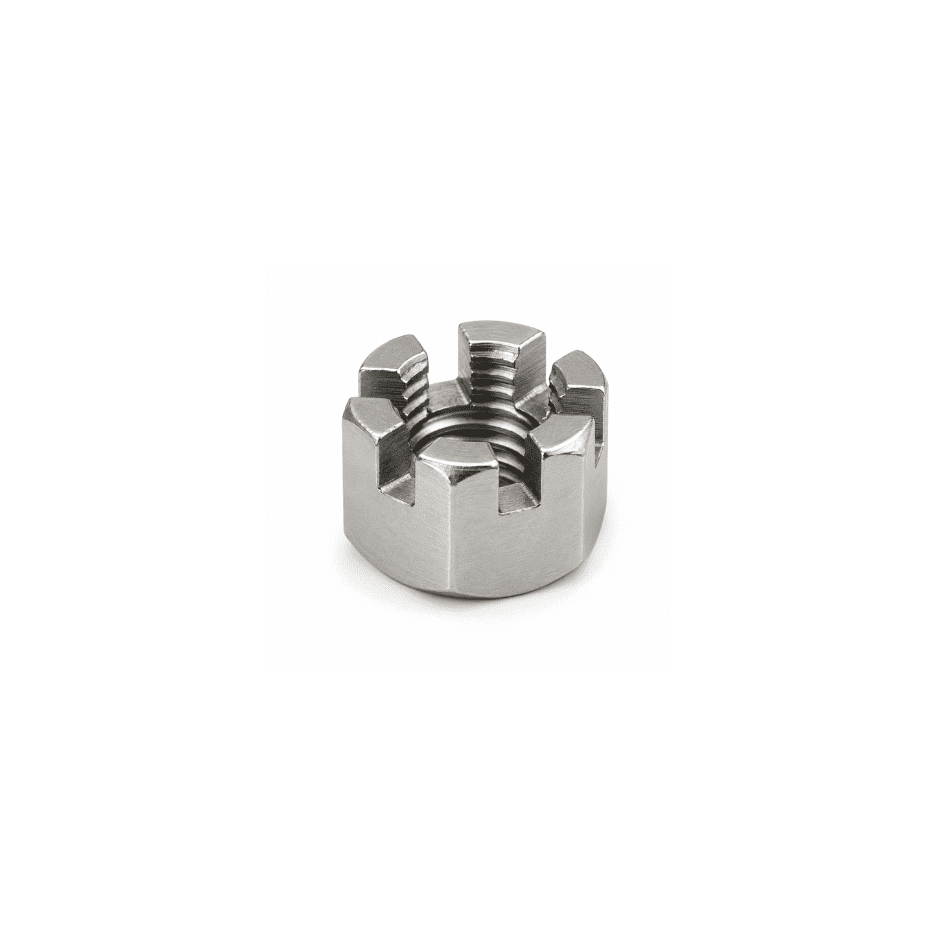
AM Steel Castle Nuts are hexagonal nuts topped with a set of slots cut into a raised, crown-like (castellated) crown – the feature that gives them their name. Manufactured under the AM Steel brand to DIN 935 (ISO 7035), these nuts (widely known as castellated nuts or slotted nuts) provide positive mechanical locking: the nut is tightened, one of its slots is aligned with a transverse hole drilled through the bolt or shaft, and a cotter pin (split pin) is passed through both – physically preventing the nut from rotating and backing off, regardless of vibration.
Because the lock is mechanical rather than friction-based, AM Steel castle nuts are the fastener of choice for safety-critical and high-vibration joints where a nut absolutely must not come loose – automotive axles, wheel bearings, steering and suspension components, tie rods, kingpins, and machinery shafts. The castellated crown allows several locking positions per turn, so the nut can be aligned to the bolt’s hole at or near the correct torque, and the cotter pin gives a clear visual confirmation that the joint is locked. Castle nuts are often used with a plain or slotted washer and typically pair with a bolt or clevis pin that has a pre-drilled cotter hole. AM Steel castle nuts are available in carbon and high-tensile steel (zinc-plated or galvanized) in property classes suited to the joint, and in stainless steel (A2/304 and A4/316, the latter considered marine-grade) for outdoor, wet, and coastal environments where corrosion resistance is critical.
Whether you’re securing axles and wheel bearings, assembling steering and suspension, fixing machinery shafts, or handling any safety-critical joint that demands positive locking, AM Steel castle nuts deliver the mechanical lock, clear visual confirmation, and consistent quality needed for vibration-proof, tamper-evident fastening. As with all AM Steel products, this castle nut is available in a range of metric sizes (typically M6 to M36 per DIN 935), in multiple grades, materials, and finishes to suit both industrial-grade and everyday fastening needs.
Key features:
- Slotted, castellated crown takes a cotter pin (split pin) through a drilled hole in the bolt
- Provides positive mechanical locking – the nut cannot rotate loose under vibration
- Multiple slot positions allow alignment to the bolt hole at or near correct torque
- Cotter pin gives clear visual confirmation that the joint is locked
- Manufactured to DIN 935 / ISO 7035 dimensional standards
- Available in carbon steel (zinc-plated, galvanized) and stainless steel (A2/304, A4/316)
- Backed by the quality assurance of AM Steel
Ideal For
AM Steel Castle Nuts are ideal for:
- Automotive axles, wheel bearings, and hub assemblies requiring a positively locked nut
- Steering and suspension components – tie rods, ball joints, kingpins – where loosening is unacceptable
- Machinery shafts and rotating assemblies subject to high vibration
- Clevis-pin and linkage connections needing a locked, retained nut
- Safety-critical joints anywhere a mechanical lock and visual confirmation are essential
Choosing the Right Castle Nut
Selecting the correct castle nut from the AM Steel range depends on several factors:
- Bolt Compatibility – The mating bolt, shaft, or clevis pin must have a transverse hole drilled for the cotter pin; confirm the hole aligns with the nut’s slots at the correct torque.
- Material – Stainless steel (A2/304 or A4/316) for outdoor, wet, or corrosion-prone applications; carbon or high-tensile steel for general and structural work.
- Strength Class – Match the nut’s property class to the bolt grade so the nut is never the weak point in the joint.
- Thread Size & Pitch – Choose the diameter and pitch to match the mating bolt or shaft exactly.
- Cotter Pin Size – Select the correct split-pin diameter and length to suit the nut’s slots and the bolt’s drilled hole.
- Washer Use – Consider a plain or slotted washer where needed to set the correct standoff so a slot aligns with the bolt hole at the target torque.
Strategies to Choose the Right Product
- Confirm the bolt has (or can take) a cotter hole – A castle nut only locks if the mating bolt or shaft is drilled for the split pin; verify the hole exists and aligns with a slot at correct torque before specifying.
- Never over- or under-torque just to align the slot – Tighten to the correct torque first; if no slot aligns with the hole, adjust with a washer or select the next position within the acceptable torque range, rather than badly over/under-tightening.
- Match the nut class to the bolt grade – Pair the property class to the bolt so the joint reaches its intended strength.
- Use the correct cotter pin and fit it properly – Fit the right-size split pin fully through the nut slot and bolt hole and bend the legs to retain it, giving a secure, visually confirmed lock.
- Match material to environment – Use stainless steel (A2/304 or A4/316) for outdoor, wet, or coastal work; zinc-plated or galvanized steel for general dry or exterior use.
- Prioritize certified standards – Look for DIN 935 / ISO 7035 compliance for guaranteed dimensional consistency.
Mechanical Properties
AM Steel Castle Nuts are manufactured to meet recognized mechanical and dimensional standards, ensuring reliability across automotive, machinery, and safety-critical locking applications:
| Property | Specification |
|---|---|
| Material Grades | Carbon Steel, High-Tensile Steel, Stainless Steel (A2/304, A4/316) |
| Governing Standard | DIN 935 / ISO 7035 (Hexagon Castle / Slotted Nuts) |
| Shape | Six-sided hexagonal body with slotted castellated crown |
| Locking Method | Cotter pin (split pin) through nut slot and drilled bolt hole — positive mechanical lock |
| Drive / Engagement | External hex flats — spanner, wrench, or socket |
| Thread Type | Internal metric thread (coarse or fine) per ISO 261 / ISO 262 |
| Size Range | M6 to M36 (metric) |
| Corrosion Resistance | Moderate (zinc-plated / galvanized steel) to high (A2/A4 stainless steel) |
| Common Alternate Names | Castellated nut, slotted nut, crown nut |
| Typical Applications | Axles, wheel bearings, steering, suspension, machinery shafts, clevis pins |
| Surface Finish | Zinc-plated, hot-dip galvanized, plain or passivated stainless steel |
These mechanical ratings confirm that AM Steel castle nuts deliver positive, vibration-proof mechanical locking suited to automotive, machinery, and safety-critical joints – tighten to correct torque, align a slot with the bolt hole, and fit the cotter pin fully for a secure, visually confirmed lock.
Frequently Asked Questions (FAQs)
1. What is a castle nut used for?
A castle nut is used on safety-critical, high-vibration joints – axles, wheel bearings, steering, and suspension – where a cotter pin through its slots and a drilled hole in the bolt positively locks the nut so it cannot vibrate loose.
2. Why is it called a castle nut?
The slotted crown on top resembles the battlements of a castle, giving the nut its name; the slots (castellations) receive the cotter pin that locks the nut to the bolt – hence also “castellated nut.”
3. How does a castle nut work?
The nut is tightened to the correct torque, one of its crown slots is aligned with a hole drilled through the bolt or shaft, and a cotter pin (split pin) is passed through both and bent over – mechanically preventing the nut from rotating loose.
4. What’s the difference between a castle nut and a nyloc nut?
A castle nut provides a positive mechanical lock via a cotter pin and gives visual confirmation it’s locked, while a nyloc nut resists loosening by friction from a nylon insert – castle nuts are preferred for safety-critical joints requiring a fail-safe, inspectable lock.
5. Are AM Steel castle nuts different from generic ones?
AM Steel castle nuts are manufactured and quality-tested under the AM Steel brand, ensuring consistent thread quality, slot dimensions, and finish across every batch, per DIN 935 / ISO 7035.
6. Does the bolt need a hole for a castle nut?
Yes – the mating bolt, shaft, or clevis pin must have a transverse hole drilled through it for the cotter pin; the castle nut only locks when a slot aligns with that hole at the correct torque.
7. What do I do if no slot lines up with the bolt hole?
Tighten to the correct torque first; if no slot aligns, use a plain or slotted washer to adjust the standoff, or move to the next slot within the acceptable torque range – never grossly over- or under-tighten just to force alignment.
8. What sizes do castle nuts come in?
AM Steel castle nuts are available in a range of sizes, typically M6 to M36 in metric, per DIN 935.
9. What cotter pin do I use with a castle nut?
Use a split pin sized to fit the nut’s slots and the bolt’s drilled hole – the correct diameter and length so it passes fully through and can be bent over to retain it securely.
10. Are castle nuts corrosion-resistant?
Yes, especially AM Steel stainless steel versions (A2/304 or A4/316), which resist rust in outdoor, wet, or coastal environments; hot-dip galvanized and zinc-plated steel offer protection for general and dry conditions.
11. Can castle nuts be reused?
The nut itself can generally be reused if its threads and slots are undamaged, but the cotter pin should always be replaced with a new one each time, as split pins are not designed to be refitted after removal.
12. What’s the difference between a castle nut and a slotted nut?
The terms are often used interchangeably; strictly, a castle nut has a distinct raised castellated crown above the hex body, while a plain slotted nut has slots cut directly into the top of the hex – both take a cotter pin to lock.
13. What’s the difference between A2 and A4 stainless steel castle nuts?
A2 (304) stainless offers good general corrosion resistance for most outdoor use, while A4 (316), considered marine-grade, provides superior resistance to chlorides and coastal or chemical environments.
Reviews
There are no reviews yet.