



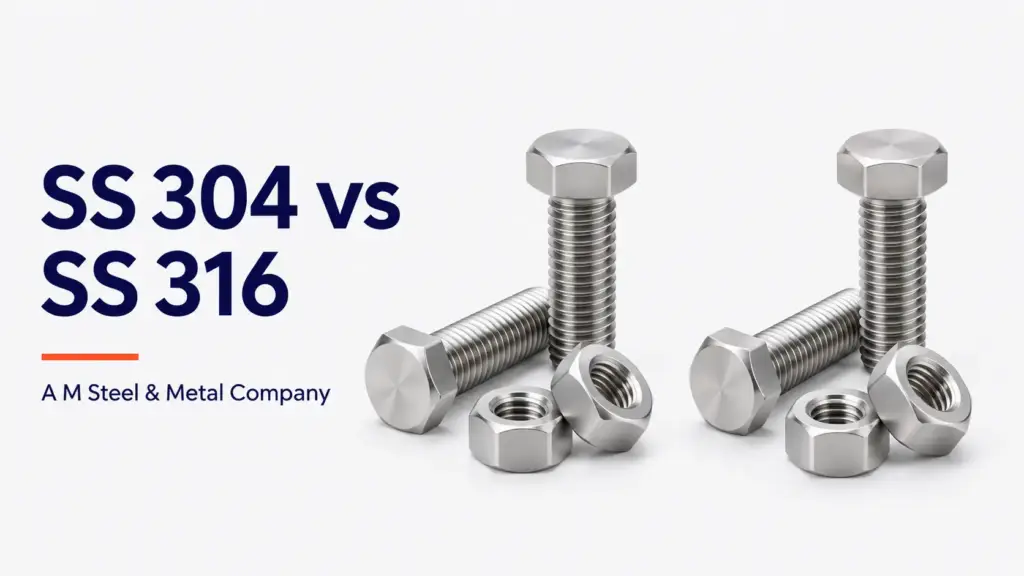
Choosing between 304 vs 316 stainless steel fasteners starts with the conditions around the joint. Indoor equipment, outdoor brackets and fittings exposed to salt do not all need the same specification. This guide explains the grade difference and the details to confirm before ordering stainless steel bolts, nuts or screws.
A M Steel & Metal Company handles stainless steel fastener enquiries from George Town, Chennai. Use the comparison below to prepare a clearer specification, then confirm the required product and documentation with the team.
What is the difference between SS 304 and SS 316?
Both are austenitic stainless steels. The useful distinction for buyers is that 316 contains molybdenum, which improves resistance to chloride-related pitting compared with 304. That makes exposure to salt an important question when comparing the two.
This does not make 316 immune to corrosion. Suitability still depends on the actual environment and joint design. A grade name alone cannot establish a safe choice for every coastal, chemical or permanently wet installation.
Start with the location of the joint
Write down where the fastener will sit, rather than describing the whole project simply as indoor or outdoor. A covered enclosure and an exposed bracket on the same site can have different conditions.
- Dry, sheltered equipment: ask whether the project specification permits SS 304.
- Salt deposits or sea spray: ask the designer to assess SS 316 or the grade specified for that exposure.
- Washdown or chemical contact: give the chemical, concentration, temperature and cleaning routine to the person selecting the material.
For a Chennai enquiry, say whether the fixing is in a sheltered workshop, on an exposed roof or near saltwater. The city name on its own is not a material specification.
How do A2 and A4 relate to 304 and 316?
A2 and A4 are stainless steel fastener material groups used in ISO 3506. They are commonly associated with 304-type and 316-type compositions respectively, but the designations are not exact substitutes for every purchasing requirement.
Keep the material group separate from the property class. For example, the 70 in A2-70 is a mechanical property designation. An item described only as SS 304 should not be assumed to have a verified A2-70 classification. Request the marking and documentation required by your drawing.
Compare quotations on the same specification
A useful comparison keeps the dimensions and commercial terms identical. Two quotations for an M10 bolt can still describe different lengths, thread pitches, standards, quantities or documentation requirements.
Send the same line-item schedule to each supplier. Separate the material grade from the product standard, and ask the supplier to identify any proposed substitution. Compare the quoted line against the drawing before accepting it. For current enquiries, see our SS 304 fasteners and SS 316 fasteners pages. Prices and availability are confirmed by quotation.
A six-point checklist before you order
- Identify the product: bolt, nut, screw, washer or stud.
- State the exact stainless steel grade and any required property class.
- Include the product standard or attach the drawing.
- List diameter, length and thread pitch for each item.
- Describe exposure, mating materials and required documentation.
- Confirm quantities, matching components and delivery postcode.
For example: “Please quote stainless steel hex bolts to the attached drawing, with the specified grade and property class, matching nuts and washers, and the stated certificate requirement.” Add your actual sizes and quantities before sending.
Send a grade-specific enquiry
Browse SS hex bolts or contact A M Steel in Chennai with your size list. Include the required grade at the first enquiry so the quotation can address the correct material. The project designer should confirm suitability for the joint.
Technical reference
Grade-group terminology checked against the British Stainless Steel Association guide to stainless steel fasteners. Corrosion background: BSSA introduction to corrosion resistance. General purchasing guidance does not certify a particular supplied batch.