



Description
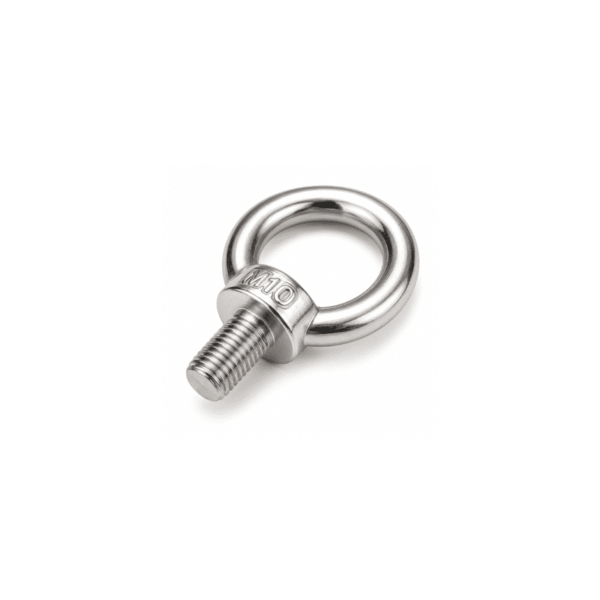
AM Steel Small Eye Bolts feature a circular loop (the “eye”) forged or formed at one end of a threaded shank, providing a convenient attachment point for hooks, ropes, cables, chains, or shackles. Manufactured under the AM Steel brand, these small eye bolts are widely used for anchoring, tie-down, guy-wire support, and general rigging tasks where a compact, low-profile loop connection is needed.
AM Steel small eye bolts are available in plain pattern (non-shoulder) and shoulder pattern designs. Plain pattern eye bolts are intended for straight, in-line vertical loads only, while shoulder pattern eye bolts have a flat collar that seats against the mounting surface, offering better resistance to angular loading when properly seated. Available in carbon steel, zinc-plated steel, and stainless steel eye bolt options, these fasteners resist corrosion and wear across a wide range of indoor and outdoor environments.
Whether you’re anchoring a tarp, securing a guy-wire, mounting a cable run, or creating a simple attachment point for light rigging, AM Steel small eye bolts are manufactured to ASME B18.15 dimensional standards and tested to ASTM A489, providing dependable, repeatable performance. As with all AM Steel products, this eye bolt is available in metric and imperial sizing, in multiple grades and finishes to suit both industrial-grade and everyday fastening needs.
Key features:
- Compact looped-head design for quick attachment of hooks, ropes, cables, and shackles
- Available in plain pattern (in-line load only) and shoulder pattern (angular load capable) designs
- Manufactured to ASME B18.15 dimensional standards, tested to ASTM A489
- Corrosion-resistant finishes: zinc-plated, galvanized, and stainless steel eye bolts
- Available in metric and imperial sizing
- Backed by the quality assurance of AM Steel
Note: This product, along with all other products in this catalog, is manufactured and supplied by AM Steel, a trusted name in industrial-grade fasteners and steel components.
Safety note: Small eye bolts are generally intended for light-duty tie-down, anchoring, and non-lifting applications unless specifically marked with a manufacturer-rated Working Load Limit (WLL) for overhead lifting. Always confirm the WLL, load direction, and applicable standard (e.g., ASME B30.26) before using any eye bolt for lifting or load-bearing purposes.
Ideal For
AM Steel Small Eye Bolts are ideal for:
- Homeowners and campers anchoring tarps, tents, awnings, and outdoor covers
- Electricians and cable installers creating simple support and anchor points for cable runs
- Boaters and marine enthusiasts securing guy-wires, fenders, and light rigging with stainless steel eye bolts
- Furniture makers and hobbyists adding attachment loops for hooks, chains, or decorative hardware
- General maintenance and DIY projects requiring a simple, low-profile loop for light-duty tie-down or anchoring
Choosing the Right Small Eye Bolt
Selecting the correct small eye bolt from the AM Steel range depends on several factors:
- Pattern Type – Plain pattern eye bolts for straight, in-line loads only; shoulder pattern eye bolts when angular loading or slightly better stability is needed.
- Material – Stainless steel eye bolts for outdoor, marine, or corrosive environments; carbon steel with zinc plating for general indoor or dry outdoor use.
- Size & Eye Diameter – Match the bolt diameter and eye opening to the hook, shackle, rope, or cable it will connect to.
- Thread Engagement – Ensure at least 1.5x the bolt diameter of thread engagement in steel (more in softer materials) for proper seating and strength.
- Load Direction – Confirm whether the application involves purely vertical, in-line loads or angular pulls, since this determines whether a plain or shoulder pattern is appropriate.
- Intended Use – Clarify whether the eye bolt is for light-duty tie-down/anchoring or for rated lifting, since these require different certification and load verification.
Strategies to Choose the Right Product
- Match the pattern to the load direction – Use shoulder pattern eye bolts if any angular pull is expected; plain pattern eye bolts only for straight vertical or in-line loads.
- Check material against environment – Choose stainless steel eye bolts for outdoor, marine, or humid conditions; zinc-plated carbon steel for indoor or general dry-use applications.
- Verify thread engagement – Ensure the mounting hole or material thickness allows sufficient thread engagement (per ASME guidance) to reach the eye bolt’s full rated strength.
- Never assume lifting capability – Confirm a manufacturer-stamped Working Load Limit and compliance with ASME B30.26 before using any eye bolt for overhead lifting; general-purpose small eye bolts are typically not intended for this.
- Buy in matched sets – Purchase eye bolts with compatible hooks, shackles, or hardware sized to the eye opening for a secure connection.
- Consider bulk vs. individual packs – Bulk packs suit large tie-down or anchoring projects; smaller packs suit single-point attachments or repairs.
Mechanical Properties
AM Steel Small Eye Bolts are manufactured to meet recognized dimensional and mechanical standards, ensuring reliability across tie-down, anchoring, and light rigging applications:
| Property | Specification |
| Material Grades | Carbon Steel, Stainless Steel (304/316) |
| Governing Standards | ASME B18.15 (dimensional), ASTM A489 (mechanical testing) |
| Pattern Types | Plain pattern (in-line load only), Shoulder pattern (angular load capable when properly seated) |
| Working Load Limit (WLL) | Manufacturer-rated only; based on a 5:1 safety factor where specified – not implied by size alone |
| Minimum Thread Engagement | 1.5× bolt diameter in steel; greater in cast iron or aluminum |
| Thread Standard | ISO metric (coarse) & UNC imperial |
| Corrosion Resistance | Moderate (zinc-plated) to high (stainless steel) |
| Operating Temperature Range | Carbon steel: -1°C to 135°C typical; consult manufacturer outside this range |
| Surface Finish | Zinc-plated, hot-dip galvanized, plain steel, stainless steel |
These mechanical ratings reflect general fastener-grade eye bolt specifications; any application involving overhead lifting or rated load-bearing requires verification of a manufacturer-stamped Working Load Limit and compliance with applicable rigging hardware standards.
Frequently Asked Questions (FAQs)
- What is a small eye bolt used for? A small eye bolt is used to create a compact attachment point for tying down tarps, securing guy-wires, anchoring cables, or connecting hooks, ropes, or light chains.
- What’s the difference between a plain pattern and shoulder pattern eye bolt? A plain pattern eye bolt is designed for straight, in-line loads only, while a shoulder pattern eye bolt has a flat collar that seats against the mounting surface, offering somewhat better resistance to angular loading when properly installed.
- Are AM Steel small eye bolts different from generic eye bolts? AM Steel small eye bolts are manufactured and quality-tested under the AM Steel brand, ensuring consistent eye dimensions, thread quality, and finish across every batch, in line with ASME B18.15 standards.
- Are small eye bolts rated for overhead lifting? Not automatically – small eye bolts are generally intended for light-duty tie-down and anchoring unless specifically stamped with a manufacturer Working Load Limit and rated to a lifting standard such as ASME B30.26.
- What sizes do small eye bolts come in? AM Steel small eye bolts are available in a range of sizes, typically from 1/8″ to 3/8″ in imperial, and M3 to M10 in metric, depending on the application.
- Are small eye bolts corrosion-resistant? Yes, especially AM Steel stainless steel eye bolts (304/316), which resist rust in outdoor or marine environments; zinc-plated carbon steel offers moderate protection for general use.
- Can small eye bolts be used at an angle? Plain pattern eye bolts should only be used for straight in-line loads; shoulder pattern eye bolts can tolerate some angular loading, but capacity is significantly reduced as the angle increases, so straight loading is always preferred.
- What tools do I need to install a small eye bolt? Hand-tightening is generally recommended for eye bolts; wrenches, pliers, or similar tools should be avoided for final tightening, especially in load-bearing applications, to prevent overstressing the eye.
- How much thread engagement does a small eye bolt need? A minimum of 1.5 times the bolt diameter of thread engagement in steel is recommended, with greater engagement needed in softer materials like aluminum.
- Can small eye bolts be reused? Yes, provided there’s no visible bending, elongation, wear, or damage to the eye or shank; any eye bolt showing such signs should be replaced, not repaired.
- What’s the difference between zinc-plated and stainless steel small eye bolts? Zinc-plated eye bolts offer basic corrosion resistance at a lower cost, while stainless steel eye bolts provide superior long-term durability and resistance to rust, especially in outdoor or marine environments.
- Do small eye bolts come with matching nuts or hardware? Some configurations require a nut underneath a through-hole installation for proper seating – always verify whether your specific eye bolt and application require a backing nut or washer per ASME installation guidance.
- What is the working load limit for a small eye bolt? Working Load Limit depends on size, material, pattern, and manufacturer rating – always refer to the manufacturer’s stamped WLL rather than assuming capacity from size alone, especially for any lifting-related use.
Reviews
There are no reviews yet.