


Description
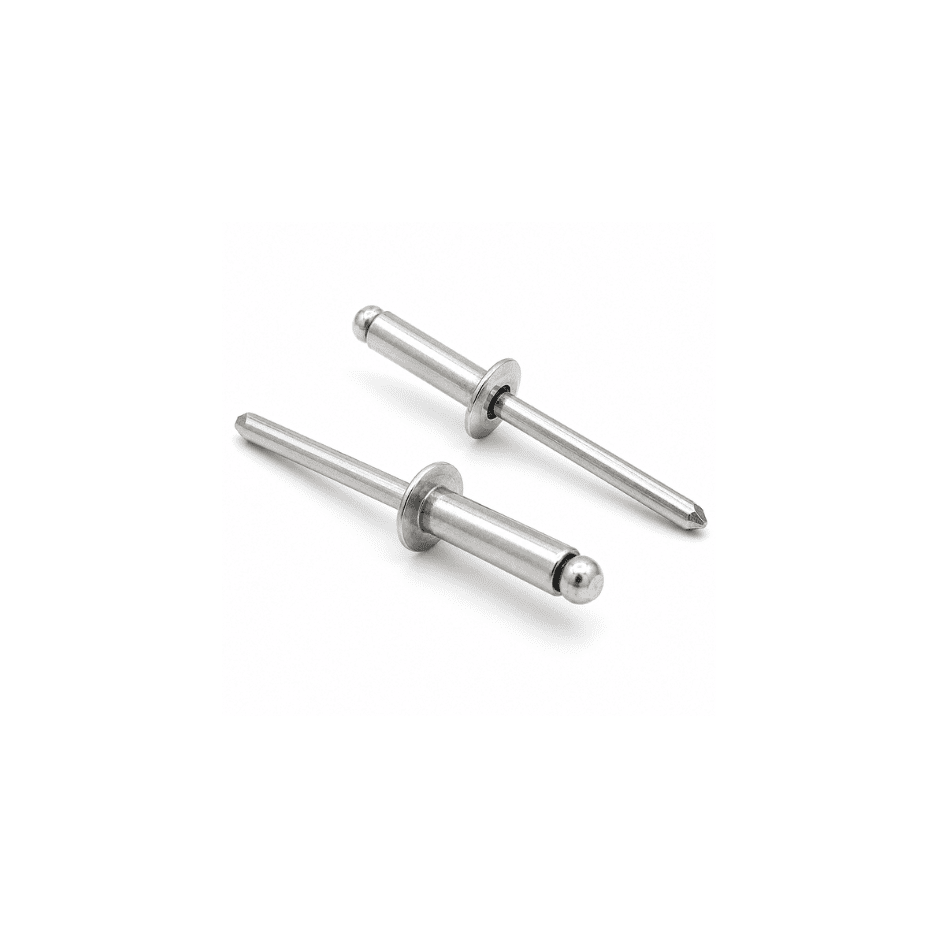
AM Steel Pop Rivets, also known as blind rivets, are unthreaded, permanent fasteners consisting of a rivet body (sleeve) and an integral mandrel. During installation, a rivet tool pulls the mandrel through the rivet body, expanding it against the back side of the joined material to form a secure, tight fixing – the mandrel then snaps off (“break mandrel”) once a set pulling force is reached. Manufactured under the AM Steel brand to DIN 7337 (which specifies dimensions, material, design, strength, and finish for break-mandrel blind rivets), this makes pop rivets an ideal solution wherever only one side of the joint is accessible during installation, such as inside enclosures, ducting, or hollow structural sections.
AM Steel pop rivets are available in dome (round) head, flat (pan) head, and countersunk head styles, and in a range of material combinations to suit different strength and corrosion requirements: aluminum body with steel or A2 stainless mandrel for general-purpose, lightweight use; A2 stainless steel body with steel or A2 stainless mandrel for higher corrosion resistance; and copper body with steel, A2 stainless, or bronze mandrel for specialized electrical or marine applications. The choice of body and mandrel material affects not just corrosion resistance but also shear and tensile strength, so matching the material combination to the joined materials and environment is an important part of specifying the right rivet.
Selecting the correct rivet also depends on matching the grip range (the combined thickness of material being joined) to the rivet’s rated grip length, and matching the rivet diameter to the hole being drilled – an incorrectly sized rivet can result in a loose, weak, or improperly set joint. AM Steel pop rivets are widely used across sheet metal fabrication, automotive body and trim work, HVAC ducting, appliance manufacturing, and general assembly wherever a strong, one-sided, permanent fastening solution is needed. As with all AM Steel products, this pop rivet is available in metric sizing (typically M3 to M6 diameter per DIN 7337, with lengths from 6mm to 25mm and beyond), in multiple materials and finishes to suit both industrial-grade and everyday fastening needs.
Key features:
- Break-mandrel design allows installation from one side only (“blind” fastening)
- Manufactured to DIN 7337, available in dome, flat, and countersunk head styles
- Available in aluminum, steel, A2 stainless steel, and copper body/mandrel combinations
- Creates a permanent, vibration-resistant mechanical joint
- Suitable for sheet metal, automotive, HVAC, and general fabrication use
- Backed by the quality assurance of AM Steel
Ideal For
AM Steel Pop Rivets (Blind Rivets) are ideal for:
- Sheet metal fabricators joining panels and enclosures where only front-side access is available
- Automotive body and trim technicians securing panels, trim pieces, and lightweight brackets
- HVAC contractors assembling and sealing ducting sections
- Appliance and equipment manufacturers completing high-volume, permanent assembly work
- General fabrication and DIY projects wherever a strong, one-sided permanent fastener is needed
Choosing the Right Pop Rivet
Selecting the correct pop rivet from the AM Steel range depends on several factors:
- Body/Mandrel Material – Aluminum body for general-purpose, lightweight use; A2 stainless steel body for corrosion resistance; copper body for specialized electrical or marine applications.
- Head Style – Dome (round) head for general use and maximum bearing surface; flat/pan head for a lower profile; countersunk head for a flush, snag-free finish.
- Grip Range – Match the rivet’s rated grip length to the combined thickness of the materials being joined — too short or too long a grip range results in a weak or improperly set joint.
- Diameter – Match the rivet diameter to the pre-drilled hole size, typically per the rivet manufacturer’s recommended hole chart.
- Environment – Choose A2 stainless steel for outdoor, marine, or corrosive environments; aluminum for lightweight, general indoor or automotive use.
- Joint Strength Requirements – Consider the shear and tensile strength needed for the application, since material combination (e.g., steel mandrel vs. stainless mandrel) affects overall rivet strength.
Strategies to Choose the Right Product
- Always match grip range to material thickness – Measure the combined thickness of all layers being joined and select a rivet with a grip range that properly covers this thickness.
- Match material to environment – Use A2 stainless steel body/mandrel rivets for outdoor, marine, or corrosive environments; aluminum for lightweight, general-purpose, or automotive use.
- Confirm hole size before installation – Drill to the rivet manufacturer’s recommended hole diameter for the specific rivet size, since an oversized or undersized hole compromises joint strength.
- Choose head style based on finish requirements – Use countersunk head rivets where a flush, snag-free surface is needed; dome head where maximum bearing area and pull-through resistance are prioritized.
- Buy in matched sets – Purchase pop rivets alongside a compatible rivet gun/tool rated for the rivet’s diameter and material.
- Consider bulk vs. individual packs – Bulk packs suit sheet metal, automotive, or appliance production runs; smaller packs suit repairs or small fabrication projects.
Mechanical Properties
AM Steel Pop Rivets (Blind Rivets) are manufactured to meet recognized mechanical and dimensional standards, ensuring reliability across sheet metal, automotive, and general fabrication applications:
| Property | Specification |
|---|---|
| Material Grades | Aluminum, Steel, A2 Stainless Steel, Copper (body); Steel, A2 Stainless Steel, Bronze Wire (mandrel) |
| Governing Standard | DIN 7337 (Break Mandrel Blind Rivets); related ISO 15973–15981 series by material/head combination |
| Head Styles | Dome (round) head, flat (pan) head, countersunk head |
| Design | Rivet body with integral break-mandrel; mandrel snaps off at a set pulling force during installation |
| Size Range | Approximately M3 to M6 diameter; lengths from 6mm to 25mm and beyond, per DIN 7337 |
| Length Tolerance | Approximately +1mm / -0.2mm (per DIN 7337) |
| Common Material Combinations | Aluminum body / steel or A2 stainless mandrel; A2 stainless body / steel or A2 stainless mandrel; Copper body / steel, A2 stainless, or bronze mandrel |
| Corrosion Resistance | Moderate (aluminum, plain steel) to high (A2 stainless steel) |
| Surface Finish | Plain, zinc/clear plated (steel), mill finish or anodized (aluminum), passivated (A2 stainless) |
These mechanical ratings confirm that AM Steel pop rivets provide dependable, permanent one-sided fastening – always match grip range, diameter, and material combination to the specific joint and environment.
Frequently Asked Questions (FAQs)
1. What is a pop rivet (blind rivet) used for? A pop rivet is used to create a strong, permanent mechanical joint when access is only available from one side of the material – common in sheet metal fabrication, automotive body work, HVAC ducting, and general assembly.
2. Why is it called a “blind” rivet? It’s called “blind” because the fastener can be fully installed and set without needing access to the back side of the joint, unlike a solid rivet which requires hammering or bucking from both sides.
3. Are AM Steel pop rivets different from generic blind rivets? AM Steel pop rivets are manufactured and quality-tested under the AM Steel brand, ensuring consistent body dimensions, mandrel break-load, and material quality across every batch, per DIN 7337.
4. What’s the difference between dome head, flat head, and countersunk head pop rivets? Dome head rivets have a rounded profile with maximum bearing surface, flat (pan) head rivets have a lower, flatter profile, and countersunk head rivets sit flush with the surface for a smooth, snag-free finish.
5. Are pop rivets corrosion-resistant? Yes, especially AM Steel A2 stainless steel pop rivets, which resist rust in outdoor, marine, or corrosive environments; aluminum rivets offer good natural corrosion resistance for general use, while plain steel offers the least without plating.
6. What sizes do pop rivets come in? AM Steel pop rivets are available in a range of sizes, typically M3 to M6 in diameter, with lengths from 6mm to 25mm and beyond, per DIN 7337.
7. How do I choose the right grip range for a pop rivet? Measure the combined thickness of all the material layers being joined, then select a rivet whose rated grip range properly covers that thickness – too short a grip range won’t clamp the joint securely, while too long a grip range can leave the mandrel improperly set.
8. What tools do I need to install a pop rivet? A rivet gun (manual, pneumatic, or battery-powered) rated for the rivet’s diameter and material is required to pull the mandrel and set the rivet.
9. Can pop rivets be removed or reused? No – pop rivets are a permanent fastener; once the mandrel snaps off and the rivet is set, it must be drilled out and replaced with a new rivet if the joint needs to be disassembled.
10. What’s the difference between an aluminum and stainless steel pop rivet? Aluminum pop rivets are lighter and more cost-effective for general-purpose use, while A2 stainless steel pop rivets offer significantly better corrosion resistance and higher strength, making them better suited to outdoor, marine, or structurally demanding applications.
11. What size hole do I need to drill for a pop rivet? The hole should match the rivet manufacturer’s recommended diameter for the specific rivet size being used – typically slightly larger than the rivet’s shank diameter to allow proper insertion without excessive play.
12. Can pop rivets be used outdoors? Yes, especially A2 stainless steel pop rivets, which are well suited to outdoor and corrosive environments; aluminum rivets are also commonly used outdoors in less demanding conditions.
13. Why does the mandrel material matter on a pop rivet? The mandrel material affects the rivet’s overall shear and tensile strength and how it interacts with the body material during setting – for example, a stainless steel mandrel is often paired with a stainless or aluminum body for improved strength and corrosion resistance compared to a standard steel mandrel.
Reviews
There are no reviews yet.